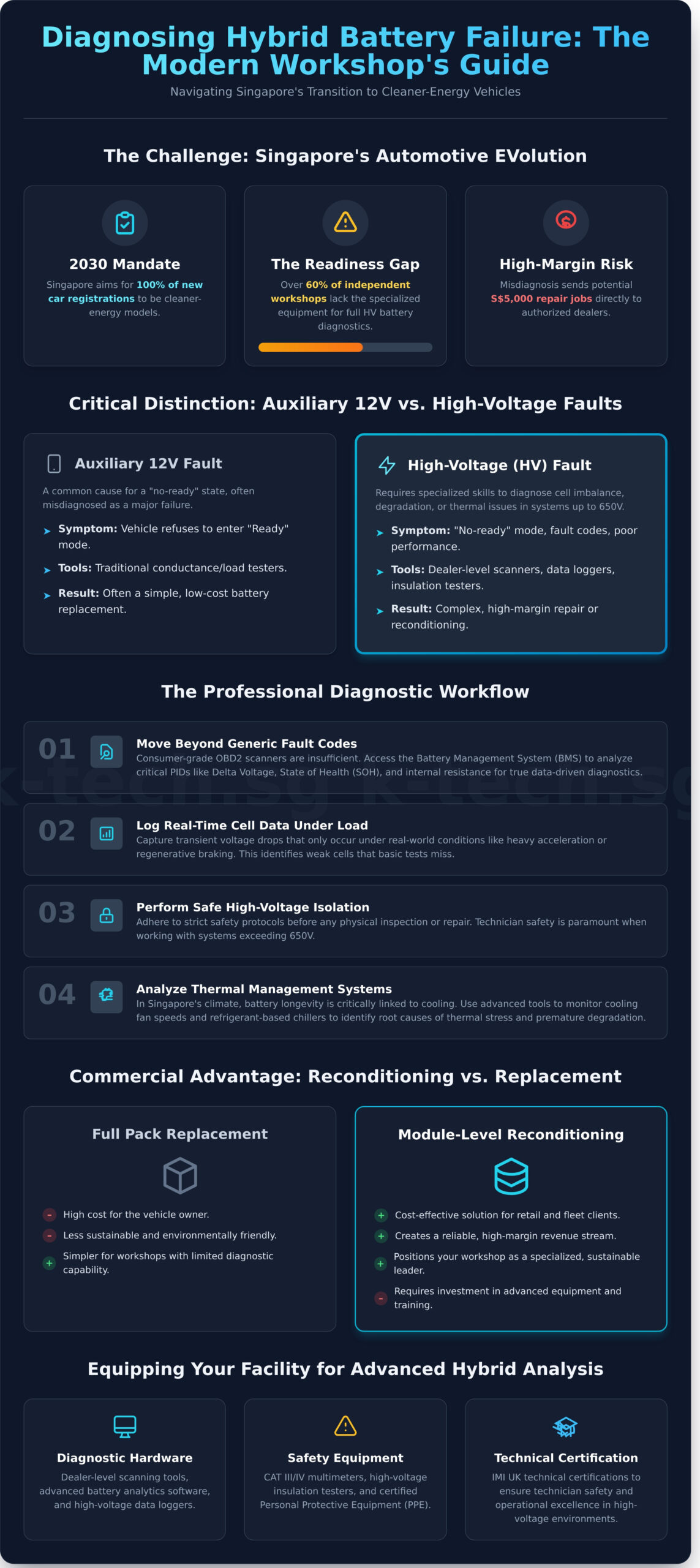
Master the technical workflows and advanced diagnostic equipment required to accurately identify high-voltage battery degradation and system failures.
The Evolution of Hybrid Battery Diagnostics for Modern Workshops
The automotive landscape in Singapore is undergoing a significant transformation, driven by the government’s 2040 goal to phase out internal combustion engine (ICE) vehicles. This shift has accelerated the demand for competent hybrid vehicle maintenance, pushing independent workshops to evolve beyond traditional methods. Diagnosing a modern hybrid system requires a fundamental change in approach, moving from simple parts replacement to sophisticated, data-driven analysis.
- Insufficient Methods: Traditional 12V battery testing protocols are inadequate for diagnosing the complex high-voltage (HV) systems in hybrid vehicles.
- The Role of BMS: The Battery Management System (BMS) is the central brain of the HV battery, constantly recording critical failure data, cell performance, and thermal trends that are inaccessible with basic tools.
- Data-Driven Diagnostics: Efficient and profitable hybrid service relies on interpreting this deep data to pinpoint faults accurately, reducing diagnostic time and avoiding unnecessary component replacement.
Understanding the Hybrid Ecosystem
A hybrid vehicle’s powertrain is an intricate ecosystem where the internal combustion engine, electric motor, and high-voltage battery pack work in constant synergy. The longevity of the battery is heavily dependent on its thermal management system, which prevents overheating and premature degradation. Professional diagnostic tools are essential to interface with proprietary manufacturer protocols, allowing technicians to view the complex interactions within this ecosystem and identify the true root cause of a failure.
The Shift from Consumer DIY to Professional Service
Consumer-grade OBD2 scanners provide only a surface-level view of a hybrid system, typically displaying generic fault codes without the granular data needed for a conclusive diagnosis. They cannot deliver the deep-cycle battery health metrics, individual cell voltages, or internal resistance data required for a professional assessment. Furthermore, improper handling of high-voltage systems presents significant liability and safety risks. By investing in professional-grade equipment and training, your workshop can position itself as a specialized service centre, capable of handling complex jobs that generalists must turn away.
Distinguishing Between Auxiliary (12V) and High-Voltage (HV) Failure
One of the most common diagnostic challenges is differentiating between a fault in the 12V auxiliary system and a failure in the main HV traction battery. While the HV battery powers the electric motor, the 12V battery is responsible for booting up the vehicle’s electronic systems, including the computers that manage the hybrid powertrain. A failure in the 12V system can often present symptoms that mimic a catastrophic HV battery failure.
- Distinct Roles: The 12V lead-acid or AGM battery powers the vehicle’s electronics and initializes the hybrid system, while the HV battery (typically NiMH or Lithium-ion) provides traction power.
- Mimicked Symptoms: Startup issues, warning lights, and non-responsive systems can originate from a weak or failing 12V battery, not the more expensive HV pack.
- Parasitic Draw: Faults in the 12V auxiliary system can create a parasitic draw, placing additional stress on the DC-DC converter and, indirectly, the high-voltage pack.
- Converter Health: Before condemning the HV battery, a professional technician must use advanced testers to verify the health of the DC-DC converter, which is responsible for charging the 12V battery from the HV system.
12V Auxiliary Battery Red Flags
A failing auxiliary battery can prevent the hybrid system’s relays and computers from activating correctly. Key indicators include Diagnostic Trouble Codes (DTCs) related to low system voltage and inconsistent vehicle startup behaviour. Testing protocols for AGM batteries in hybrid vehicles are particularly important, as their charging and load characteristics differ from standard lead-acid batteries.
High-Voltage Battery Failure Indicators
True HV battery failure manifests differently. Technicians should look for rapid and erratic fluctuations in the State of Charge (SOC) during operation, even under light load. Other critical indicators include thermal runaway warnings from the BMS, cooling fans running excessively, and data showing significant spikes in internal resistance across specific battery modules, pointing to internal degradation.
Professional Diagnostic Workflow: Beyond Generic Fault Codes
A professional diagnosis of hybrid battery failure goes far beyond reading generic P0A80 "Replace Hybrid Battery Pack" codes. A systematic, data-led workflow is required to isolate the exact point of failure, enabling more precise and cost-effective repairs.
- Comprehensive System Scanning: Begin by using a dealer-level diagnostic system, such as the Autel MaxiSys, to pull manufacturer-specific DTCs from all relevant modules, including the Battery Energy Control Module (BECM) and the hybrid powertrain control module.
- Real-Time Data Logging: Monitor and log individual cell voltages in real-time. Place the system under various load conditions (e.g., hard acceleration, regenerative braking, idle) to observe how each cell responds. Weak cells will show a more significant voltage drop under load.
- High-Voltage Isolation Testing: Perform a high-voltage insulation test using a megohmmeter to check for any current leakage between the HV components and the vehicle chassis. This is a critical safety and performance check.
- Delta Voltage Analysis: Analyse the "Delta V" or "Delta SOC" metrics. This data reveals the imbalance between battery modules. A high delta voltage indicates that some modules are significantly weaker than others, disrupting the pack’s overall performance.
- Cooling System & Contactor Verification: Inspect and test the battery pack’s cooling system (fans, ducts, and sensors) for proper operation. Use the diagnostic tool to command the battery contactors (relays) to open and close, verifying their mechanical and electrical integrity.
Advanced Data Stream Analysis
Interpreting the live data stream from the BECM is the cornerstone of advanced diagnostics. By load testing the vehicle and observing the voltage drop across each module, a technician can identify the "weak links" in the battery’s series string. For clarity, Delta Voltage is the maximum difference between the highest and lowest cell voltages in a pack; a large and persistent difference is a primary indicator of internal failure.
Safety Protocols for Technicians
Working with systems that can exceed 400 volts demands strict adherence to safety protocols. There is no room for error.
- Mandatory PPE: Always use Class 0 (1000V) rated insulated gloves and appropriately insulated tools.
- Service Disconnect: Before any physical work begins, properly remove the high-voltage service plug/manual disconnect to isolate the battery pack from the rest of the vehicle.
- Zero Voltage Verification: After disconnecting, use a CAT III or IV rated multimeter to verify a zero-voltage state between the high-voltage terminals before any components are touched or removed.
Commercial Implications: Reconditioning vs. Replacement
The ability to accurately diagnose battery failure at the module level opens up significant commercial opportunities for independent workshops. Instead of presenting a customer with a single, high-cost quote for a full battery pack replacement, you can offer a more nuanced and affordable solution.
- Cost and Retention: New HV batteries are extremely expensive in Singapore, often leading customers to scrap an otherwise functional vehicle. Offering a reconditioning service drastically improves customer retention.
- Diagnostic Precision: Pinpointing specific faulty modules allows for targeted repairs, such as replacing only the degraded cells, rather than the entire multi-thousand-dollar pack.
- ROI on Equipment: Investing in specialized EV and hybrid tools provides a clear return on investment. The ability to perform just one or two battery reconditioning jobs can often cover the cost of the diagnostic equipment, protecting high-margin work that would otherwise go to authorized dealers.
- Building Trust: Providing customers and fleet operators with transparent, data-backed battery health reports builds immense trust and establishes your workshop as a technical authority.
The Business Case for Battery Reconditioning
The profit margin on a battery reconditioning service—which involves replacing weak modules and balancing the entire pack—is significantly higher than that of simply selling and installing a new pack. This service not only extends the life of the vehicle for the owner but also increases workshop throughput. Furthermore, by repairing instead of replacing, your workshop aligns with Singapore’s Green Plan 2030, reducing electronic waste and promoting a circular economy.
Fleet Management and Preventive Diagnostics
For commercial clients like taxi and ride-hailing fleets, vehicle uptime is paramount. Offering preventive diagnostic services is a powerful value proposition.
- Scheduled Health Checks: Implement regular battery health checks to monitor degradation trends across the fleet.
- Predictive Maintenance: Use diagnostic data to predict when a battery pack is likely to fail, allowing for maintenance to be scheduled before a catastrophic failure strands a vehicle.
- Resale Value: Detailed diagnostic reports on battery health can significantly enhance the resale value of commercial hybrid vehicles, providing a tangible benefit for fleet managers.
Equipping Your Facility for Advanced Hybrid Analysis
To capitalize on the growing hybrid market, workshops must invest in the right combination of equipment, training, and facility layout. This foundational investment is what separates leading workshops from the competition.
- Diagnostic Hardware: The Autel MaxiSys EV series has become a workshop standard, providing dealer-level diagnostic capabilities, battery pack analysis, and topology mapping for a wide range of hybrid and electric vehicles.
- Technical Training: Staff competence and safety are non-negotiable. Technicians must receive technical training and certification, such as programmes developed in partnership with leading local institutions like Temasek Polytechnic, to handle high-voltage systems safely and effectively.
- Workshop Layout: Designate a specific, clearly marked area for high-voltage service. This area should be clean, well-lit, and equipped with the necessary safety equipment, including insulated tools, rescue hooks, and appropriate signage.
- End-to-End Partnership: Partner with a specialist like K-Tech for a comprehensive solution that includes equipment supply, software updates, and ongoing technical support for your workshop’s specific needs.
The K-Tech Advantage for Singapore Workshops
As the exclusive Singapore distributor for Autel, K-Tech provides workshops with more than just tools. We deliver an integrated ecosystem designed for success. This includes exclusive access to genuine Autel diagnostic hardware and software updates, customized training programs for everything from EV battery calibration to ADAS, and dedicated local technical support to assist with complex diagnostic challenges and workshop setup.
Next Steps for Workshop Owners
Future-proofing your business starts with an honest assessment of your current capabilities.
- Conduct a gap analysis to identify the tools and skills your workshop currently lacks for professional hybrid diagnostics.
- Schedule a certified training session for your lead technicians to ensure they are prepared for the technical and safety demands of HV systems.
- Enquire about our specialized EV/Hybrid training programmes to build a clear roadmap for elevating your workshop’s service offerings and profitability.
Frequently Asked Questions
What are the most common DTCs associated with hybrid battery failure?
The most famous is P0A80 (Replace Hybrid Battery Pack), but professional diagnostics look deeper at manufacturer-specific codes related to cell voltage imbalance (e.g., P3011-P3029 for specific blocks in a Toyota), isolation faults (P0AA6), and battery module temperature sensor circuits.
Can a hybrid vehicle operate if the high-voltage battery has failed?
In most cases, no. If the BMS detects a critical fault, it will prevent the high-voltage contactors from closing, rendering the hybrid system inoperable. The vehicle will not start or run, as it cannot draw power from the HV battery.
How long does a professional hybrid battery diagnostic test take?
A comprehensive diagnostic test, including data logging under various load conditions and insulation testing, typically takes between 1.5 to 3 hours. This is far more in-depth than a simple 15-minute code scan.
Is specialized insurance required for workshops handling high-voltage batteries in Singapore?
While standard public liability insurance is required, workshops should consult with their insurance provider to ensure their policy adequately covers risks associated with high-voltage electrical work on vehicles. Documented training and certification can help in securing appropriate coverage.
What is the difference between battery balancing and reconditioning?
Battery balancing is a process where all modules in a pack are charged or discharged to an equal state of charge. Reconditioning is a more comprehensive process that includes balancing but also involves identifying, replacing, and testing weak or failed modules to restore the pack’s overall health and capacity.
How often should a workshop recommend a hybrid battery health check for fleet vehicles?
For high-mileage fleet vehicles, a comprehensive battery health check is recommended annually or every 20,000-25,000 kilometres. This allows for early detection of degradation and helps in planning for maintenance to maximize vehicle uptime.
Do I need a separate diagnostic tool for every hybrid car brand?
No. Advanced, multi-brand diagnostic platforms like the Autel MaxiSys series are designed to cover a wide range of manufacturers, providing dealer-level capabilities for most major Asian, European, and American hybrid models in a single tool.
What safety certifications are required for technicians in Malaysia and Singapore?
While regulations are evolving, the industry standard is to ensure technicians have completed certified training on high-voltage vehicle safety and repair. Programmes developed with recognized institutions, such as our partnership with Temasek Polytechnic, provide the necessary credentials to demonstrate competence and adherence to safety protocols.
Speak to our technical team about upgrading your hybrid diagnostic capabilities
- Exclusive Singapore distributor for Autel diagnostic tools
- Technical Training in Partnership with Temasek Polytechnic
- Specialized in B2B workshop system integration