The rapid evolution of automotive technology, from complex ADAS calibrations to high-voltage EV systems, presents a significant challenge for workshops across Singapore. Relying on outdated tools can lead to diagnostic inaccuracies, reduced car throughput, and diminishing profit margins, making it difficult to compete in a demanding market. The strategic integration of advanced workshop equipment is no longer an option but a critical necessity for operational excellence and sustainable growth.
This guide provides a definitive framework for workshop owners to navigate these challenges. We will outline a clear strategy for selecting and implementing high-ROI equipment that directly addresses modern vehicle complexities. By following this guide, you will gain the insights needed to enhance diagnostic accuracy, increase technician productivity, and unlock new, high-margin revenue streams from EV and ADAS servicing. Prepare to transform your operational capabilities and secure your workshop’s position as a leader in Singapore’s advanced automotive ecosystem.
Key Takeaways
- The rise of software-defined vehicles necessitates a fundamental shift in workshop capabilities beyond traditional mechanical expertise.
- Strategically investing in core equipment categories unlocks new, high-margin revenue streams such as ADAS calibration and EV battery diagnostics.
- Adopt a structured investment framework to select advanced workshop equipment, shifting from simple tool acquisition to building long-term technical capabilities.
- Integrating diagnostic tools and management software creates a connected workshop ecosystem, significantly improving workflow efficiency and reducing diagnostic errors.
The Shift to a High-Tech Automotive Ecosystem: Why Standard Equipment is Obsolete
The modern vehicle is no longer a purely mechanical machine; it is a sophisticated, software-defined computer on wheels. The rapid integration of complex electronics and onboard networks has rendered traditional repair methods obsolete. This transformation highlights the ongoing technological evolution of the mechanic’s job, where digital proficiency is now as critical as mechanical skill. For workshops in Singapore, relying on standard equipment is a direct path to operational irrelevance. Upgrading to advanced workshop equipment is the only way to service the modern vehicle fleet and secure future profitability.
The Challenge of Electric & Hybrid Vehicles
The growing prevalence of Electric Vehicles (EVs) and hybrids on Singaporean roads introduces service demands that standard tools cannot meet. Servicing these vehicles requires specialized equipment for handling high-voltage systems safely, diagnosing intricate Battery Management Systems (BMS), and maintaining unique EV powertrain and thermal management components. Without the proper insulated tools and diagnostic software, workshops are unequipped to service this expanding and profitable vehicle segment.
The Precision Required by ADAS
Advanced Driver-Assistance Systems (ADAS)-including features like lane-keeping assist and automatic emergency braking-are now standard on most new vehicles. Common procedures such as wheel alignments, suspension repairs, or windscreen replacements necessitate precise recalibration of ADAS sensors and cameras. Failure to perform these calibrations correctly not only compromises vehicle safety but also exposes a workshop to severe liability risks. Professional ADAS calibration equipment is essential for ensuring accuracy and compliance.
Complex Onboard Diagnostics (OBD)
Basic OBD2 scanners are insufficient for modern vehicles. Today’s complex systems require OEM-level diagnostic capabilities that offer bi-directional control to test components and perform advanced coding functions. Accessing manufacturer-specific trouble codes is impossible with generic tools, leading to inaccurate diagnoses and inefficient repairs. Investing in professional diagnostic systems is fundamental to accurately servicing a diverse range of modern vehicle brands.
Ultimately, turning away customers with modern vehicle issues is not a sustainable business strategy. Each rejected service appointment represents lost revenue, potentially amounting to thousands of Singapore Dollars (S$) weekly, and damages your workshop’s reputation. The acquisition of advanced workshop equipment is no longer an optional upgrade but a critical investment for survival, ensuring your business remains competitive and profitable within today’s high-tech automotive ecosystem.
Core Pillars of a Modern Workshop: Equipment for Maximum ROI
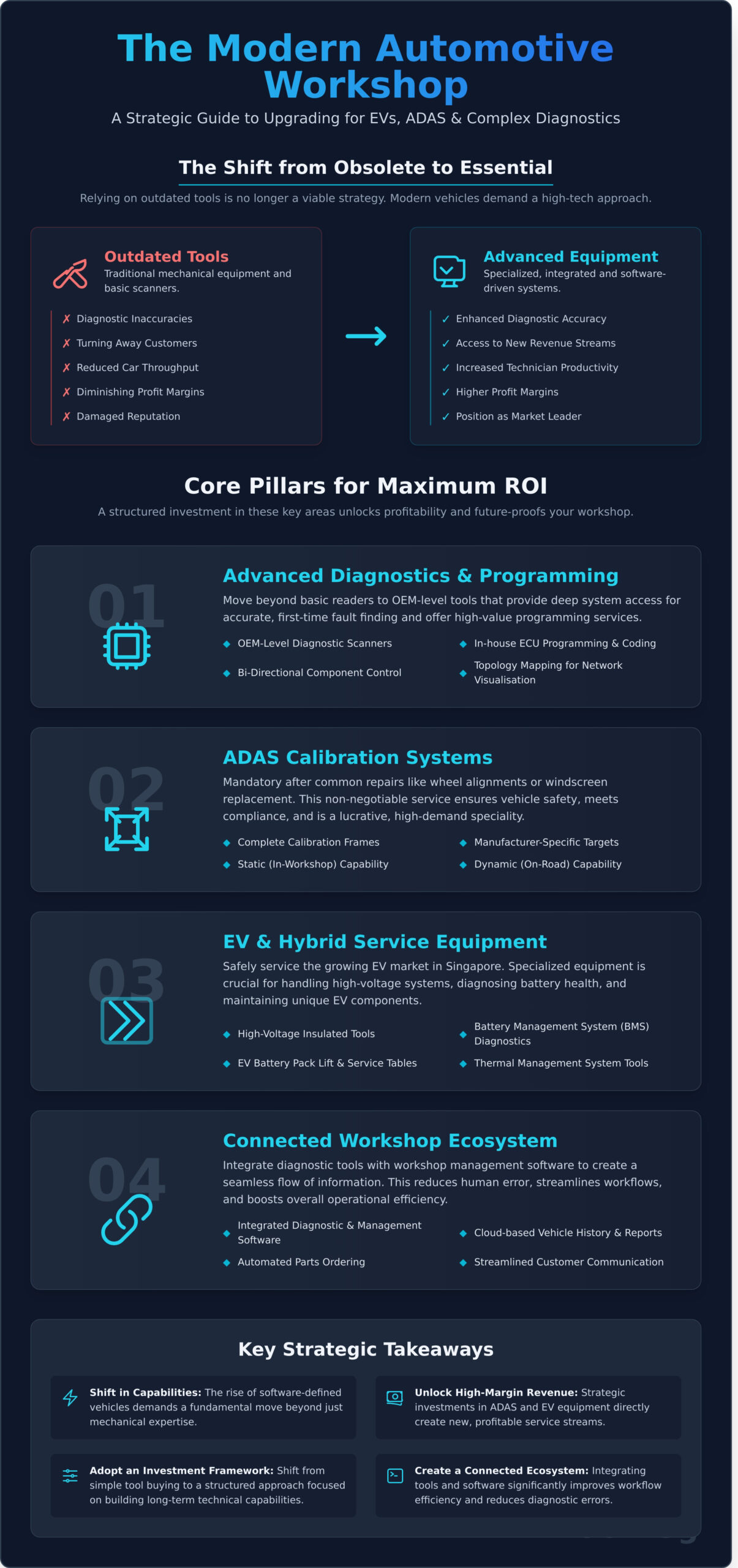
Investing in the right advanced workshop equipment is not merely an operational upgrade; it is a strategic business decision that directly impacts profitability and market positioning. To maximize return on investment (ROI), modern workshops must build their capabilities around four core pillars. Each pillar represents a distinct functional area that unlocks new, high-margin revenue streams and drives significant gains in operational efficiency, transforming your workshop into a comprehensive service centre for today’s complex vehicles.
Pillar 1: Advanced Diagnostics and Programming
Moving beyond basic OBD2 readers is critical. OEM-level diagnostic scanners, such as those from Autel, provide the deep system access required for accurate, first-time fault finding. This capability reduces non-billable diagnostic hours and increases job throughput. Furthermore, offering in-house ECU programming and coding opens up a high-value service that many competitors cannot provide. Modern tools with topology mapping allow technicians to instantly visualize vehicle networks, drastically speeding up the diagnostic process for complex electronic issues. Explore our range of Autel Diagnostic Solutions.
Pillar 2: ADAS Calibration Systems
Advanced Driver-Assistance Systems (ADAS) are now standard on new vehicles. Any service that affects vehicle geometry, from windscreen replacement to suspension work, mandates a precise ADAS recalibration. A complete system, including a calibration frame and a comprehensive set of manufacturer-specific targets, is essential. Workshops must be equipped for both static (in-workshop) and dynamic (on-road) calibration. The complexity of these systems means that performing this work correctly requires specialized training and equipment to ensure vehicle safety and compliance, creating a non-negotiable and lucrative service opportunity.
Pillar 3: EV & Hybrid Service Equipment
To capitalize on Singapore’s accelerating transition to electric vehicles, workshops must invest in specialized EV and hybrid service equipment. This is not only about future-proofing but also about accessing a growing, high-margin market segment. Essential investments include:
- High-voltage safety gear, including insulated tools and certified gloves.
- Dedicated battery pack lifters for safe and efficient battery removal.
- Advanced battery analysis tools to diagnose state-of-health (SOH).
- EV charger testers to troubleshoot charging system faults.
Pillar 4: High-Efficiency Mechanical Equipment
Foundational mechanical tasks can be a major source of revenue, and modern equipment dramatically increases their efficiency and quality. Upgrading to a 3D wheel aligner, for example, can cut alignment times by more than half while delivering superior accuracy. Similarly, investing in modern car lifts designed with EV battery access ensures versatility for servicing both traditional and electric vehicles. This category of advanced workshop equipment, including advanced tire changers and wheel balancers, directly boosts a workshop’s daily car count and service quality.
A Strategic Framework for Equipment Investment and Selection
Acquiring new advanced workshop equipment is a critical business decision that extends far beyond a simple transaction. To secure a competitive advantage in Singapore’s dynamic automotive market, workshop owners must shift their mindset from merely ‘buying a tool’ to strategically ‘investing in a capability’. This requires a long-term technology roadmap that anticipates industry shifts towards Electric Vehicles (EVs) and Advanced Driver-Assistance Systems (ADAS). A methodical approach avoids common pitfalls, such as prioritising low initial costs over long-term value and support, ensuring every dollar invested contributes directly to sustainable growth and operational excellence.
Part of this strategic approach involves thorough research into the available technology. Consulting online publications that provide detailed reviews and comparisons, such as SuggestMeTech, can help you evaluate different equipment options and identify the best fit for your workshop’s specific needs.
Calculating Return on Investment (ROI)
A sound investment in equipment must deliver a measurable financial return. To calculate ROI, workshop owners should project gains from new high-demand services-such as ADAS calibration, which can generate S$250-S$400 per vehicle, or specialized EV battery diagnostics. Also, factor in efficiency improvements; advanced diagnostic tools can reduce fault-finding time by over 50%, increasing daily vehicle throughput. Use the standard formula to quantify the benefit: ROI = (Gain from Investment – Cost of Investment) / Cost of Investment.
Evaluating Suppliers: Beyond the Price Tag
The true cost of equipment is not reflected on the initial invoice. Choosing a supplier based solely on price is a significant risk that often leads to greater long-term expenses from downtime and unsupported technology. A strategic partner provides a comprehensive support ecosystem, including responsive local technical assistance, genuine software updates for the latest vehicle models, and a robust local warranty. A supplier who also offers professional training demonstrates a vested interest in your operational success, making them an integral part of your business growth.
The Critical Role of Technician Training
The most sophisticated equipment is rendered ineffective without highly skilled technicians to operate it. Therefore, an investment in technology must be matched by a parallel investment in professional training. Certified technicians can fully leverage the capabilities of advanced tools, ensuring accurate diagnostics and repairs while boosting workshop efficiency. Furthermore, IMI-certified qualifications build immense customer trust, justifying premium pricing for specialized services and solidifying your workshop’s reputation for quality. Upskill your team at our IMI-accredited Training Academy.
Integrating Your Equipment for a Smart, Efficient Workshop
The true potential of modern automotive technology is realised not through the capability of a single tool, but through comprehensive system integration. Moving beyond isolated pieces of equipment to a networked, cohesive ecosystem is the definitive step towards superior operational efficiency. When your advanced workshop equipment communicates seamlessly, you create a data-driven workflow that minimises human error, reduces diagnostic-to-repair time, and elevates the quality of your service delivery. This transition from manual data entry and fragmented processes to an automated, centralised system is fundamental for workshops in Singapore aiming for sustainable growth and industry leadership.
Workshop Management Systems (WMS)
A Workshop Management System (WMS), such as the cloud-based solution offered by TrackMyBusiness, acts as the central nervous system for your entire operation. It centralises critical administrative tasks, including digital job cards, parts inventory, invoicing, and detailed customer service histories. The most significant advantage emerges when diagnostic tools are integrated to feed vehicle data, fault codes, and completed service reports directly into the corresponding job card. This automation provides managers with unparalleled operational oversight, ensuring complete accuracy and traceability from vehicle check-in to final invoicing.
Cloud-Based Diagnostics and Repair Data
Modern diagnostic tools are no longer just for reading codes; they are gateways to a global network of information. The integration of advanced workshop equipment with cloud-based platforms offers immense benefits for technical accuracy and efficiency.
- Access to OEM Data: Technicians gain instant access to vast, continuously updated online databases containing OEM repair procedures, wiring diagrams, and known-fix information, improving first-time fix rates.
- Remote Expert Assistance: Complex diagnostic challenges can be resolved faster through remote programming and expert assistance features, connecting your technicians with specialists in real-time.
- Professional Documentation: Generate, save, and share professional vehicle health reports directly from the diagnostic tool. This enhances customer communication by providing clear, transparent documentation of all work performed and creates a valuable service history for every vehicle.
Building this integrated framework transforms a workshop into a forward-thinking, data-driven operation. To learn more about creating a fully integrated automotive solution, explore the professional systems offered by K-Tech Auto Solution.
Your Strategic Partner in Workshop Modernization
The evolution of the automotive industry into a complex digital ecosystem demands a fundamental shift away from obsolete tools. As this guide has outlined, a strategic investment in integrated, high-ROI advanced workshop equipment is no longer a luxury but a foundational requirement for achieving superior operational efficiency and sustainable growth.
Navigating this technological landscape requires an expert partner. As the exclusive Singapore distributor for Autel diagnostic systems and an IMI (UK) accredited Technical Training Academy, K-Tech Auto Solution offers an unparalleled understanding of the modern workshop. Our proven track record in complete workshop setup and consultancy ensures we provide not just equipment, but a comprehensive, end-to-end technical solution tailored to your business needs.
Take the definitive step toward future-proofing your operations. Request a complimentary workshop needs analysis with our specialists and let us partner with you to build a more efficient, capable, and profitable future for your automotive business.
Frequently Asked Questions About Advanced Workshop Equipment
What is the most critical piece of advanced equipment to invest in first?
The most critical initial investment is determined by your workshop’s primary service offerings. For most modern automotive businesses, a professional-grade, multi-brand diagnostic scanner is the foundational tool for accurate fault finding. For workshops aiming to service newer vehicles, particularly electric or hybrid models, specialized battery diagnostic and maintenance equipment is becoming equally essential to expand technical capabilities and improve operational efficiency. This strategic first step forms the basis for more complex repairs.
How can I finance a significant investment in new workshop equipment?
In Singapore, workshops can leverage several financing avenues for significant capital expenditure. Government-supported programmes, such as the Enterprise Development Grant (EDG), can co-fund projects that upgrade business capabilities and productivity. Additionally, many established equipment suppliers offer flexible leasing or hire-purchase options. These arrangements allow you to manage cash flow by aligning payments with the revenue generated by the new equipment, preserving capital for other operational needs.
What is the real difference between genuine and ‘clone’ diagnostic tools?
The difference is substantial and directly impacts your workshop’s credibility and operational integrity. Genuine diagnostic tools receive regular, official software updates, ensuring compatibility with the latest vehicles and access to professional technical support. Conversely, ‘clone’ tools often use pirated software, lack reliable updates, and can provide inaccurate data. This can lead to incorrect diagnoses, component damage, and significant legal and financial liability for your automotive business.
How do I ensure the equipment I buy today won’t be obsolete in three years?
Future-proofing your investment requires selecting equipment from manufacturers committed to long-term support and continuous development. Prioritize systems that are modular and receive consistent software updates to accommodate new vehicle technologies like those in EVs and ADAS. Partnering with an established solutions provider ensures you invest in globally recognized brands with a clear product roadmap. This strategic approach is key to maximizing the return on your investment in advanced workshop equipment.
How much space is required for equipment like an ADAS calibration frame?
The space requirement for an Advanced Driver-Assistance Systems (ADAS) calibration frame is significant and must be precise for accurate results. A workshop typically needs a clear, level bay of at least 7 meters in length and 4 meters in width. This dedicated area must be free of obstructions and have controlled, non-reflective lighting conditions. It is critical to consult the specific manufacturer’s guidelines, as requirements can vary between systems to ensure calibration accuracy.
Can advanced equipment help my workshop get insurance-approved repair work?
Yes, definitively. Possessing certified advanced workshop equipment, particularly for ADAS calibration and structural repairs, is increasingly a prerequisite for joining insurance companies’ approved repairer networks in Singapore. Insurers require verifiable proof that repairs are completed to manufacturer standards for safety and liability. Documented use of professional-grade equipment provides this assurance, directly enhancing your workshop’s eligibility for high-quality, insurance-based repair contracts and strengthening your market position.