The rapid integration of Advanced Driver-Assistance Systems (ADAS) is no longer a future trend-it is the present reality on Singapore’s roads. For workshop owners, this technological shift presents both a significant challenge and a substantial opportunity. The uncertainty surrounding high investment costs in S$, concerns over liability from incorrect procedures, and the fear of being outpaced by competitors can be overwhelming. Navigating this new landscape requires a strategic approach and a deep understanding of the advanced adas calibration systems now essential for modern vehicle servicing.
This comprehensive guide is designed to address these critical concerns directly. We will provide a clear roadmap for automotive professionals, demystifying the core principles of ADAS calibration and outlining the factors for selecting the right equipment to ensure a positive return on investment. By the end, you will be equipped to make an informed purchasing decision, develop a profitable new revenue stream, and confidently ensure every repair meets stringent OEM safety standards. This is your essential resource for transforming a technological challenge into a cornerstone of your workshop’s sustainable growth.
What is ADAS Calibration? Core Principles for Technicians
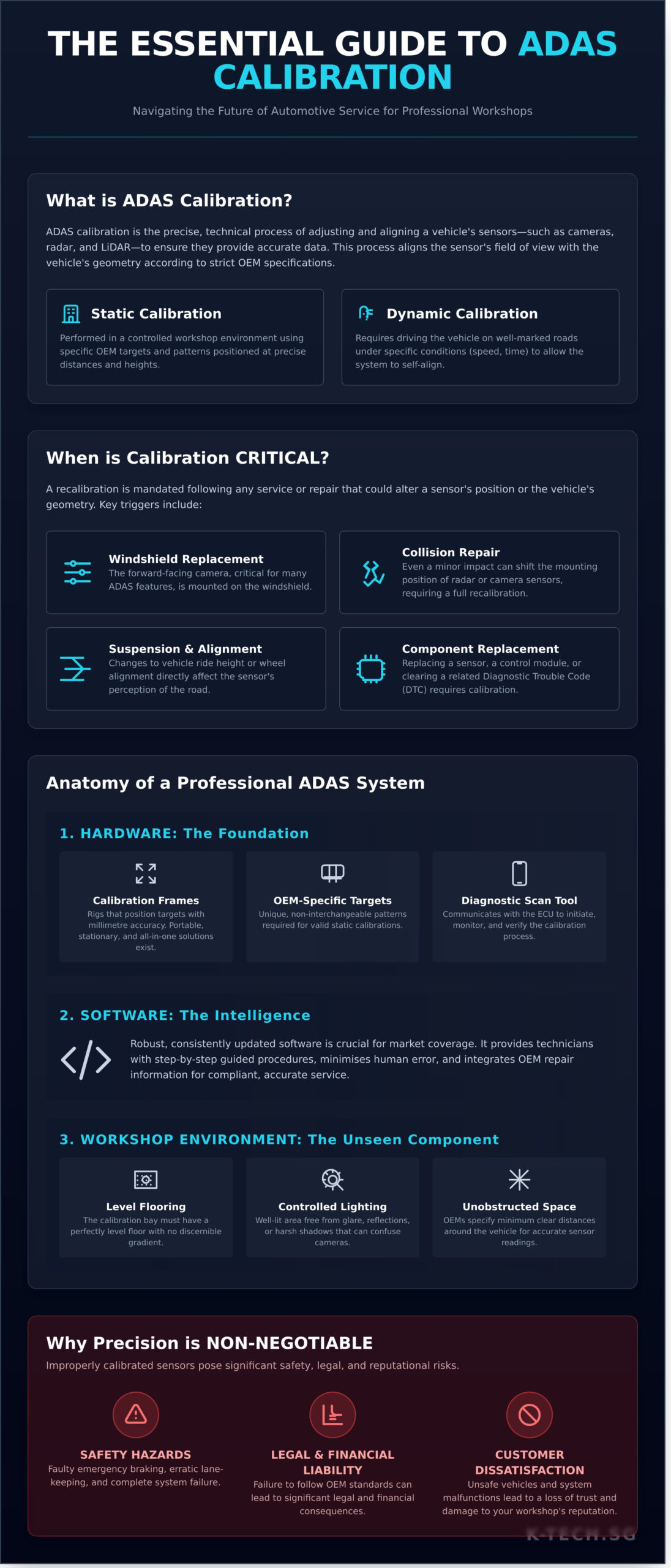
In modern vehicles, safety and functionality are increasingly managed by a sophisticated network of onboard sensors. This network forms the foundation of what are known as Advanced driver-assistance systems (ADAS), which include features like Autonomous Emergency Braking (AEB), Lane Keep Assist (LKA), and Adaptive Cruise Control (ACC). These systems rely on cameras, radar, and LiDAR sensors to interpret the vehicle’s environment and react accordingly. For these systems to function as intended, their sensors must be perfectly aligned with the vehicle’s geometry.
ADAS calibration is the precise, technical process of adjusting and aligning these sensors to ensure they provide accurate data to the vehicle’s computer. This procedure aligns the sensor’s field of view with the vehicle’s thrust line, following strict Original Equipment Manufacturer (OEM) specifications. The process requires specialized adas calibration systems and is broadly categorized into two primary methods: static calibration, performed in a controlled workshop environment with specific targets, and dynamic calibration, which requires driving the vehicle under specific conditions to allow the system to self-align.
Why Precise Calibration is Non-Negotiable
Improperly calibrated ADAS sensors pose a significant safety risk. A misaligned camera or radar can feed incorrect data to the system, leading to delayed or faulty activation of emergency braking, erratic lane-keeping behaviour, or complete system failure. For automotive workshops in Singapore, performing calibration to exact OEM standards is not just a matter of best practice; it is a critical aspect of operational liability. Failure to do so can result in unsafe vehicles, customer dissatisfaction, and significant legal and financial consequences.
When is ADAS Calibration Required?
A recalibration of the ADAS is mandated following a range of common service and repair procedures. Technicians must be prepared to perform a calibration in any scenario where a sensor’s position or the vehicle’s geometry could have been altered. Key triggers include:
- Windshield Replacement: The forward-facing camera, a critical component for many ADAS features, is typically mounted on the windshield. Its replacement necessitates a full recalibration.
- Collision Repair: Even a minor impact can subtly shift the mounting position of radar or camera sensors, requiring a comprehensive diagnostic and calibration service.
- Suspension & Alignment: Any changes to vehicle ride height or wheel alignment directly affect the sensor’s perception of the road, mandating a calibration to restore accuracy.
- Component Replacement: The replacement of a sensor, a related control module, or the presence of a Diagnostic Trouble Code (DTC) related to an ADAS fault requires calibration.
Anatomy of a Professional ADAS Calibration System
A professional ADAS calibration system is not a single tool, but an integrated ecosystem of advanced hardware, intelligent software, and a meticulously controlled environment. Each component is integral to the operational success of accurately recalibrating a vehicle’s safety systems to OEM specifications. The objective is to restore the precise alignment of cameras and sensors, a requirement underscored by safety authorities; the NHTSA on ADAS provides extensive information on how these technologies are fundamental to modern vehicle safety. Achieving this precision requires a synergistic approach where every element functions flawlessly.
Hardware: Frames, Targets, and Scanners
The physical components form the foundation of any calibration procedure. The primary hardware includes the calibration frame, a set of targets, and a diagnostic scan tool. These elements work in concert to create a controlled reference point for the vehicle’s sensors.
- Calibration Frames: These rigs ensure targets are positioned with millimetre accuracy relative to the vehicle. Options range from portable systems for mobile service, stationary frames for dedicated workshop bays, to advanced all-in-one solutions that integrate digital positioning for maximum efficiency.
- OEM-Specific Targets: Each vehicle manufacturer utilises unique patterns and designs for its targets. These are not interchangeable. Using the correct, high-quality target is non-negotiable for a valid static calibration.
- Diagnostic Scan Tool: This device acts as the brain of the operation. It communicates directly with the vehicle’s ECU to initiate the calibration procedure, provides live data feedback, and ultimately verifies a successful recalibration.
Software: The Key to Vehicle Coverage
If hardware is the foundation, software is the intelligence that drives modern adas calibration systems. The most sophisticated frame is ineffective without robust software that is consistently updated. For a diverse vehicle market like Singapore, comprehensive software is crucial for a workshop’s viability. It provides technicians with step-by-step, guided procedures for thousands of different models, minimising the risk of human error. Furthermore, leading software platforms integrate OEM repair information, providing direct access to official procedures and specifications required for a compliant and accurate service.
Workshop Environment: The Unseen Component
The final, critical component is the workshop environment itself. Inaccurate results are often traced back to a suboptimal workspace. Three environmental factors are paramount for precision:
- Level Flooring: The calibration bay must have a perfectly level floor with no discernible gradient to ensure the frame and vehicle are on the same plane.
- Controlled Lighting: The area must be well-lit but free from glare, reflections, or harsh shadows that can interfere with a camera’s ability to recognise calibration targets.
- Unobstructed Space: Manufacturers specify minimum clear distances in front of and around the vehicle. This unobstructed space is essential for correct target placement and to prevent sensor interference.
Selecting the Right ADAS Calibration Equipment for Your Workshop
Investing in an ADAS calibration system is a significant strategic decision for any modern workshop in Singapore. To ensure a strong return on investment, your choice must be meticulously aligned with your specific operational context. The right equipment enhances your service capabilities, improves workshop efficiency, and future-proofs your business against evolving vehicle technology. Key decision factors include the primary vehicle brands you service, your available workshop space, and your allocated budget.
Key Evaluation Criteria for Your Investment
A comprehensive evaluation of adas calibration systems goes beyond the initial purchase price. Your assessment should be based on a framework of long-term value and operational integration. Consider these critical factors:
- Vehicle Make/Model Coverage: The system must offer extensive coverage for the Japanese, Korean, and Continental vehicle makes prevalent on Singapore’s roads. Ensure its database is consistently updated to include the latest models.
- OEM-Compliance: Adherence to manufacturer-approved procedures is non-negotiable for ensuring safety and limiting liability. Industry benchmarks, such as the SAE ADAS Calibration Standard, highlight the importance of precise, repeatable processes, making OEM-compliance a core feature of any professional-grade system.
- Ease of Use & Workflow: An intuitive interface with guided, step-by-step instructions is crucial. This reduces the learning curve for technicians and minimizes the time required for each calibration, directly boosting productivity.
- Technical Support & Updates: Reliable, local post-sales support is indispensable. Confirm that the provider offers prompt technical assistance and a clear schedule for software and vehicle coverage updates to keep your equipment current.
Static vs. Dynamic vs. Hybrid Systems
ADAS calibration procedures are broadly categorized into static and dynamic methods. Static calibrations are performed in a controlled workshop environment using specific targets and patterns. This method offers high precision but requires dedicated, level floor space. Dynamic calibration, conversely, is performed on the road, requiring the vehicle to be driven under specific conditions. While it demands less physical equipment, it is dependent on weather and traffic. Leading-edge hybrid solutions, such as those from Autel, integrate both capabilities. This provides workshops with maximum flexibility to service a wider range of vehicles and calibration requirements efficiently, regardless of the OEM’s specified procedure.
The K-Tech Advantage: Sourcing the Best Equipment
Navigating the market for advanced workshop equipment requires specialized expertise. As an exclusive distributor for globally recognized brands like Autel, K-Tech Auto Solution provides more than just hardware. We deliver an integrated solution that includes expert consultation, comprehensive IMI-accredited training, and dedicated local after-sales support. Choosing a specialized provider ensures you acquire not just a tool, but a complete support ecosystem designed to maximize your investment.
Partner with an industry leader to ensure your workshop is equipped for the future of automotive service. Explore our range of ADAS calibration systems.
Building a Profitable ADAS Service: ROI and Implementation
Integrating Advanced Driver-Assistance Systems (ADAS) calibration into your workshop’s service portfolio is no longer an option-it is a strategic imperative for sustainable growth. For automotive businesses in Singapore, offering this specialized service provides a high-value, essential revenue stream, positioning your workshop as a leader in handling the complexities of modern vehicles. This transition requires a calculated investment in technology and training, but the return on investment (ROI) and enhanced market position are substantial.
Calculating Your Potential ROI
A comprehensive ROI analysis begins with understanding both the initial outlay and the projected revenue. The primary investments include:
- Equipment Costs: Acquiring professional-grade adas calibration systems, such as those from Autel, can range from S$20,000 to S$40,000 for a complete setup.
- Training Expenses: Certifying technicians through accredited programmes like those offered by K-Tech is critical for ensuring precision and safety. Budget for professional training fees per technician.
- Technician Time: While efficient systems minimise downtime, factor in the 30-60 minutes required per calibration.
Revenue generation is robust. In the Singapore market, a single static or dynamic calibration following common jobs like windscreen replacement, bumper repair, or wheel alignment can command between S$250 and S$500. By performing just a few calibrations per week, a workshop can quickly recoup its initial investment while attracting high-value B2B referrals from body shops and windscreen specialists not equipped to perform these essential procedures.
Integrating ADAS into Your Workflow
To maximise operational efficiency and ensure consistent quality, ADAS services must be seamlessly integrated into your standard procedures. A robust workflow includes:
- Standard Operating Procedures (SOPs): Implement mandatory pre- and post-repair diagnostic scans on all incoming vehicles to accurately identify required calibrations.
- Comprehensive Documentation: Generate and store detailed calibration reports for every procedure. This documentation is vital for customer transparency, internal quality control, and insurance claim validation.
- Service Advisor Training: Equip your front-line staff to effectively communicate the non-negotiable safety-critical nature of ADAS calibration to customers, framing it as an integral part of the repair, not an optional add-on.
By developing these capabilities, your workshop not only creates a profitable service but also builds a reputation for technical excellence and uncompromising safety standards. To explore the industry-leading equipment and IMI-accredited training required to build your ADAS capabilities, visit k-tech.sg to partner with Singapore’s premier automotive solutions provider.
The Critical Role of ADAS Technician Training and Certification
As Advanced Driver-Assistance Systems (ADAS) become standard in modern vehicles, their maintenance has created a new, highly specialized discipline within automotive repair. ADAS calibration is not an extension of general mechanics; it is a meticulous science that demands an exceptional level of precision. A minor error in sensor alignment-even by a single millimetre or degree-can corrupt the system’s data, leading to incorrect vehicle responses and potentially catastrophic safety failures. This high-stakes environment requires technicians to have deep procedural knowledge and proficiency with sophisticated adas calibration systems.
For automotive workshops in Singapore, investing in formal technician training and certification is a strategic imperative. A certified team elevates a workshop’s credibility, providing customers with the assurance that their vehicle’s complex safety features are being handled by qualified professionals. This distinction is also critical for insurance claims and liability management. Documented, industry-standard training demonstrates due diligence and a commitment to safety, protecting the business while building a reputation for excellence and trust.
What to Look for in an ADAS Training Program
Selecting the right training partner is vital for developing genuine technical capability. An effective program moves beyond theory to offer extensive hands-on practice, as proficiency is built through application. It is also crucial that training is conducted on the specific equipment your workshop uses, enabling your team to translate their new skills directly into operational efficiency. Finally, always look for programs with globally recognized accreditations to guarantee the curriculum meets rigorous industry standards.
- Comprehensive Curriculum: Covering sensor technology, OEM-specific procedures, and diagnostic principles.
- Practical Application: Emphasizing hands-on time with modern calibration tools and targets.
- Industry Accreditation: Endorsement from respected bodies, such as the Institute of the Motor Industry (IMI).
Upskill Your Team with K-Tech’s Training Academy
K-Tech Auto Solution bridges the gap between technology and talent with our IMI-accredited Technical Training Academy. Our courses are meticulously designed to equip technicians with the future-proof skills needed to master complex adas calibration systems as they continue to evolve. We provide an integrated automotive solution, ensuring the training your team receives is perfectly aligned with the advanced equipment we supply. This seamless approach enhances workshop productivity and positions your business as a leader in automotive safety.
Invest in your team’s expertise to secure your workshop’s competitive advantage. View our ADAS technician training courses.
Positioning Your Workshop for the Future of Automotive Service
The integration of Advanced Driver-Assistance Systems is fundamentally reshaping the automotive service landscape in Singapore. As we have explored, mastering ADAS calibration is no longer a niche specialisation but a core requirement for ensuring vehicle safety and operational excellence. Success depends on a comprehensive understanding of calibration principles, investment in professional adas calibration systems, and a firm commitment to ongoing technician training. These elements are the pillars of a profitable and reputable ADAS service division.
K-Tech Auto Solution provides a complete, end-to-end technical solution to empower your workshop. As the exclusive Singapore distributor for globally recognised Autel diagnostic and ADAS systems, and an IMI (UK) accredited Technical Training Academy, we offer an integrated ecosystem-from advanced equipment to technician certification. We are your strategic partner in building a high-performance ADAS capability.
Request a consultation on the ideal ADAS solution for your workshop. Embrace the future of automotive service and secure your workshop’s sustainable growth.
Frequently Asked Questions About ADAS Calibration
How much does a professional ADAS calibration system cost?
The investment for a professional ADAS calibration system in Singapore typically ranges from S$20,000 to over S$60,000. The final cost is contingent on factors such as the system’s OEM coverage, diagnostic capabilities, and the inclusion of targets for advanced features like around-view monitoring. Workshops should consider this a strategic investment in technical capability, essential for servicing the growing fleet of modern vehicles equipped with sophisticated safety features and ensuring operational readiness for complex repairs.
What is the difference between static and dynamic ADAS calibration?
Static ADAS calibration is performed within a controlled workshop environment using specialized targets placed at precise, manufacturer-specified distances from the vehicle. This method is common for front-facing cameras after a windscreen replacement. In contrast, dynamic calibration requires a technician to drive the vehicle on well-marked roads at specific speeds, allowing the onboard systems to self-calibrate using real-world road conditions. Many modern vehicles require a combination of both procedures to ensure complete system accuracy.
How long does a typical ADAS calibration service take?
The duration for a professional ADAS calibration service generally ranges from 30 minutes to over two hours. The exact time is dependent on the vehicle’s make and model, the specific sensors requiring calibration (e.g., camera, radar, LiDAR), and whether a static, dynamic, or combined procedure is mandated by the OEM. Comprehensive pre-calibration checks, such as verifying tyre pressure and vehicle ride height, are a critical part of the process and also contribute to the overall service time.
What happens if a vehicle’s ADAS is not calibrated correctly after a repair?
Failure to perform correct ADAS calibration after a relevant repair introduces significant safety risks. It can lead to critical system malfunctions, where features like Automatic Emergency Braking or Lane Keep Assist may fail to activate or, conversely, trigger incorrect interventions, potentially causing an accident. Inaccurate calibration can also generate persistent fault codes and warning lights, eroding driver confidence in the vehicle’s safety technology and exposing the repair facility to considerable liability.
Is ADAS calibration required after every wheel alignment?
Yes, ADAS calibration is a mandatory procedure following a four-wheel alignment. The alignment process directly alters the vehicle’s thrust angle and its relationship to the geometric centerline. Since forward-facing ADAS sensors rely on this centerline as a primary reference point, any adjustment requires recalibration to ensure the systems can accurately perceive the vehicle’s position and trajectory. Neglecting this step compromises the operational integrity of crucial safety features like Lane Departure Warning and Adaptive Cruise Control.
Can any workshop perform ADAS calibration, or is special training needed?
Performing ADAS calibration correctly demands specialized technical training and advanced diagnostic equipment. Technicians must possess a thorough understanding of sensor technology, OEM-specific procedures, and the operational parameters of various adas calibration systems. Professional competency, often validated through industry certifications such as those from the Institute of the Motor Industry (IMI), is essential for ensuring precise and safe outcomes. Merely possessing the equipment without the requisite expertise is insufficient and poses a significant risk.