Establishing a successful car workshop in Singapore in 2026 demands more than just mechanical skill; it requires a strategic fusion of regulatory compliance, advanced technical infrastructure, and a forward-thinking business model. This definitive roadmap is designed for automotive entrepreneurs, investors, and fleet managers, providing the critical insights needed to navigate Singapore’s complex landscape and build a profitable, future-ready facility equipped for the era of Electric Vehicles (EV) and Advanced Driver Assistance Systems (ADAS).
Navigating the Regulatory Framework for Singapore Workshops
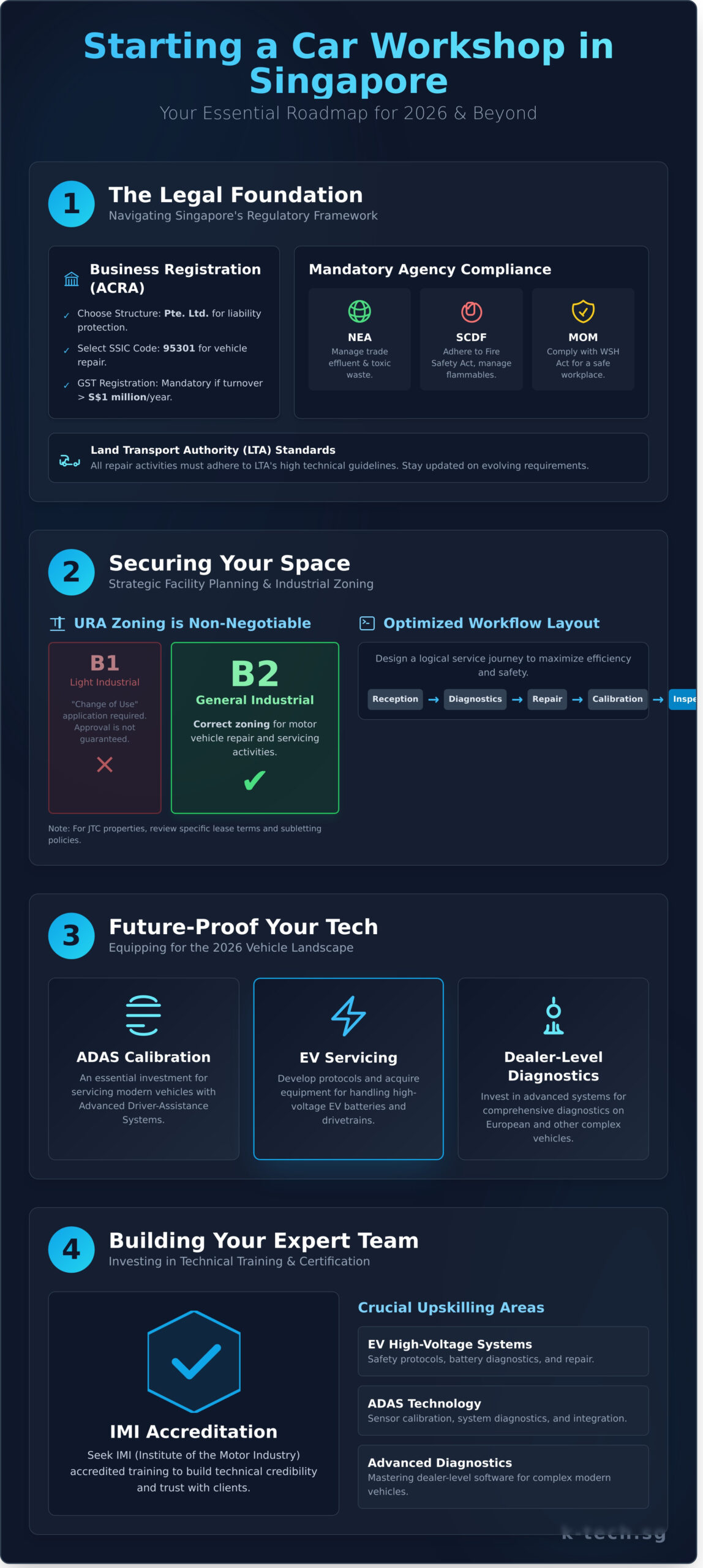
Securing the correct licenses and adhering to national standards is the foundational first step. A compliant workshop not only operates legally but also builds trust with clients and partners. The key agencies to engage with are ACRA, NEA, SCDF, and LTA.
-
ACRA Registration: The first step is to formally register your business with the Accounting and Corporate Regulatory Authority (ACRA) and select the appropriate legal structure.
-
NEA Compliance: The National Environment Agency (NEA) governs environmental impact, focusing on the proper management of trade effluent and hazardous materials common in automotive repair.
-
SCDF Fire Safety: The Singapore Civil Defence Force (SCDF) mandates strict fire safety protocols, especially for facilities handling flammable liquids and high-voltage EV batteries.
-
LTA Standards: While LTA does not issue a single "workshop license," your operations must adhere to its standards for vehicle inspections and authorized repair procedures to maintain industry credibility.
Core Licensing and Business Registration
For long-term protection and scalability, registering as a Private Limited (Pte. Ltd.) company is the recommended pathway. This structure limits personal liability and enhances professional credibility. The process involves registering your business name and activities via the Bizfile+ portal, ensuring you select the correct Singapore Standard Industrial Classification (SSIC) codes for motor vehicle repair and maintenance. Furthermore, if your workshop’s projected annual turnover is expected to exceed SGD 1 million, you are required to register for Goods and Services Tax (GST).
Environmental and Safety Compliance
Operational compliance extends beyond business registration. You must secure the necessary NEA permits for the discharge of trade effluent into the public sewerage system and establish a contract with a licensed Toxic Industrial Waste Collector for the disposal of used oil, solvents, and batteries. For larger workshops, appointing a certified Fire Safety Manager (FSM) may be mandatory. All operations must strictly comply with the Workplace Safety and Health (WSH) Act, implementing risk assessments and safe work procedures specific to automotive environments, such as protocols for vehicle lifting and high-voltage system handling.
Strategic Facility Planning and Industrial Zoning
The physical location and layout of your workshop are critical determinants of operational efficiency and profitability. Choosing the right industrial zone and designing an optimised floor plan are essential for managing workflow, ensuring technician safety, and accommodating modern vehicle technologies.
URA and JTC Zoning Requirements
In Singapore, automotive workshops are typically restricted to specific industrial zones designated by the Urban Redevelopment Authority (URA). The primary distinction is between:
-
B1 (Light Industrial): Suitable for light industrial activities that do not create significant noise, vibration, or pollution. Some clean and non-disruptive automotive activities may be permitted.
-
B2 (General Industrial): Designated for general industrial use, including activities with greater environmental impact, making it the standard zoning for most comprehensive car workshops.
If a potential premise was not previously used for automotive work, you must apply for "Change of Use" approval from the URA. For properties under JTC Corporation, it is crucial to understand the specific lease terms, usage restrictions, and subletting policies that apply.
Workshop Layout and Workflow Optimization
An efficient workshop layout directly impacts vehicle throughput and profitability. The design should facilitate a logical flow from diagnostics to repair and final quality control. Key considerations include:
-
Allocating specialized zones: Designate separate, clearly marked areas for ADAS calibration and high-voltage EV service. These zones require controlled environments and specific safety infrastructure.
-
Optimizing bay design: Ensure each work bay provides sufficient space for technicians to work safely and efficiently around a vehicle, with easy access to tools and diagnostic equipment.
-
Ensuring proper infrastructure: Adequate ventilation to extract fumes and bright, precision lighting are non-negotiable for ensuring high-quality technical work and a safe environment.
Technical Infrastructure: Equipping for the 2026 Vehicle Landscape
The transition from a general repair shop to a modern technical facility hinges on investing in the right equipment. For 2026 and beyond, success means being equipped to service complex European vehicles, ADAS-equipped cars, and the growing fleet of EVs and Hybrids.
Advanced Diagnostic and Calibration Systems
Basic OBD2 scanners are no longer sufficient. Modern vehicles require dealer-level diagnostic tools that can perform complex coding, programming, and system initialisation. To remain competitive, your workshop must invest in:
-
Multi-brand diagnostic platforms: Select advanced systems that offer OEM-level functionality across a wide range of makes, particularly European models prevalent in Singapore.
-
ADAS calibration equipment: With features like adaptive cruise control and lane-keeping assist now standard, a dedicated ADAS calibration unit is essential for post-repair safety and compliance.
-
Specialized automotive equipment: High-precision wheel aligners, smart vehicle lifts, and advanced battery analysers are core components of a modern workshop’s equipment inventory.
EV and Hybrid Readiness
Servicing high-voltage vehicles is a specialised discipline that demands a stringent focus on safety and specific equipment. Key infrastructure includes:
-
Insulated tools and PPE: A complete set of 1000V-rated insulated tools and personal protective equipment (PPE) is mandatory for any technician working on EV battery systems.
-
High-voltage testing equipment: Procure specialised tools for battery health diagnosis, insulation testing, and de-energising procedures.
-
Dedicated EV service areas: Establish clearly marked "High Voltage" work zones with safety barriers, appropriate signage, and access to dedicated EV charging points for post-service validation.
Human Capital: Technical Training and IMI Certification
Advanced equipment is only as effective as the technicians operating it. In Singapore’s competitive market, accredited certification is a powerful differentiator that signals technical excellence and builds trust with discerning clients, especially corporate fleet operators.
Accredited Certification Pathways
Investing in continuous education is crucial for retaining talent and reducing costly diagnostic errors. Workshop owners should explore:
-
IMI UK certifications: The Institute of the Motor Industry (IMI) is a globally recognised standard. Certifications in EV/Hybrid systems and ADAS calibration provide a verifiable benchmark of technician competency.
-
Structured training programs: Enrolling technicians in a professional technical training academy ensures they are proficient with the latest diagnostic procedures and vehicle technologies.
-
Government upskilling grants: Investigate available government subsidies and grants designed to support workforce development and help defray the cost of specialised technical training.
Attracting and Retaining Skilled Talent
A skilled workforce is your workshop’s most valuable asset. To attract and retain top technicians, define clear career progression paths, from apprentice to diagnostic specialist. Investing in modern, safe, and efficient equipment not only improves workshop output but also significantly boosts technician morale and job satisfaction. Establishing internal Standard Operating Procedures (SOPs) for complex tasks ensures consistency and facilitates knowledge sharing within the team.
Long-term Growth and Strategic Technical Partnerships
Launching a workshop is just the beginning. Sustainable success requires a long-term vision focused on strategic growth, operational excellence, and adapting to technological shifts.
Workshop Setup Consultancy
Engaging a professional workshop setup consultant can prevent costly initial mistakes in facility design and equipment procurement. An experienced technical partner provides end-to-end solutions, from floor plan optimisation to selecting the right diagnostic ecosystem for your business goals. This strategic collaboration ensures your workshop is launched seamlessly and is technically prepared from day one.
Independent Operation vs. Franchise Networks
A key strategic decision is whether to operate as a fully independent workshop or join an established franchise network.
-
Franchise Model: Joining a network, such as those operated by brands like Motoserv or Mr. Kool, offers immediate brand recognition, proven operational systems, and group purchasing power. However, this comes with franchise fees and less autonomy over branding and service offerings.
-
Independent Model: An independent workshop retains full control over its brand identity, service specialisation (e.g., focusing on European cars or EVs), and supplier relationships. This provides greater flexibility but requires building a brand and customer base from scratch.
The choice of model will influence your marketing and operational strategy, but the foundational requirements for technical excellence, regulatory compliance, and future-ready equipment remain constant for both paths.
Sustainable Growth and Future-Proofing
To ensure long-term viability, consistently monitor the return on investment (ROI) for high-value equipment like ADAS calibration rigs and EV diagnostic systems. Stay informed about national initiatives like Singapore’s "Green Plan 2030," which will accelerate the transition to EVs and create new opportunities for prepared workshops.
Final Checklist for a Successful 2026 Workshop Launch:
-
Business registered with ACRA (Pte. Ltd. recommended).
-
All NEA, SCDF, and WSH permits and protocols in place.
-
Facility secured in an appropriate URA/JTC industrial zone (B2 preferred).
-
Workshop layout optimised for safety and workflow.
-
Core technical equipment procured, including dealer-level diagnostics, ADAS calibration, and EV service tools.
-
Technicians enrolled in accredited IMI training programs.
-
A clear business model (independent or franchise) is defined.
Ready to build a technically superior and commercially successful workshop? Speak to our technical team for a comprehensive workshop setup consultation.
Frequently Asked Questions
Do I need a specific license from the LTA to start a car workshop in Singapore?
There is no single "workshop license" issued by the Land Transport Authority (LTA). However, your business must be registered with ACRA, and your operations must comply with various standards set by agencies like NEA and SCDF. For specific activities like vehicle inspections, separate LTA authorisations are required.
What is the minimum electrical requirement for a workshop intending to service EVs?
A workshop servicing EVs should have a three-phase power supply to support Level 2 or AC chargers for post-service testing. A licensed electrical worker must assess your premises to ensure the electrical load and infrastructure can safely support high-voltage charging and diagnostic equipment.
How much capital is typically required to equip a modern automotive workshop in Singapore?
Capital expenditure varies significantly based on specialisation and scale. A basic setup can start from SGD 150,000, while a comprehensive facility equipped with advanced diagnostics, ADAS calibration, and EV service systems can require an investment upwards of SGD 400,000.
Can I operate a car workshop in a B1 industrial space?
Generally, comprehensive car workshops involving activities that may generate noise, fumes, or effluent are designated for B2 (General Industrial) zones. Some limited, low-impact automotive activities might be permissible in B1 (Light Industrial) spaces, but this requires explicit approval from the URA.
Is IMI certification mandatory for automotive technicians in Singapore?
While not legally mandatory, IMI (Institute of the Motor Industry) certification is fast becoming the industry benchmark for quality and competence. For workshops aiming to secure corporate fleet contracts or service high-value modern vehicles, having IMI-certified technicians is a significant competitive advantage.
What are the NEA requirements for disposing of used engine oil and batteries?
Used engine oil, coolant, solvents, and batteries are classified as toxic industrial waste. Workshops are legally required to engage a licensed Toxic Industrial Waste Collector for their proper collection, transport, and disposal. You must maintain records of all disposal transactions for NEA inspection.
What happens if my workshop is not compliant with SCDF fire safety codes?
Non-compliance with SCDF’s Fire Safety Act can result in severe penalties, including fines, imprisonment, and immediate stop-work orders until all violations are rectified. This includes having certified fire extinguishers, proper storage of flammable materials, and clear emergency exit routes.
How can specialized diagnostic tools improve my workshop’s profitability?
Specialized, dealer-level diagnostic tools reduce diagnostic time, increase accuracy, and prevent guesswork that leads to repeat jobs. This allows you to complete more jobs per day (higher throughput) and take on complex, higher-margin repairs that workshops with basic tools must turn away, directly boosting profitability.