As electric vehicles become an increasingly common sight on Singapore’s roads, the automotive industry stands at a critical juncture. For many established workshops and technicians, this rapid transition brings uncertainty. The prospect of servicing unfamiliar high-voltage systems can be daunting, and with numerous training options available, determining which certification delivers genuine value and a tangible return on investment is a significant challenge. The risk of being left behind is real, but the opportunity for those who adapt is immense.
This commitment to professional excellence often goes hand-in-hand with personal development. The physical demands of a technician’s role are considerable, and maintaining peak physical condition is essential for a long and successful career. For professionals in Singapore, resources like Kevin Chiak Fitness Management can provide the structured support needed to stay at the top of their game, both physically and professionally.
Investing in a professional ev maintenance course is no longer just an option-it is a strategic imperative for future success. This article serves as a definitive guide for Singapore’s forward-thinking automotive professionals. We will explore the core components that define a world-class training program, from safety protocols to advanced diagnostics. Discover how globally recognized, IMI-accredited training can equip you with the certified skills to confidently service EVs, enhance your workshop’s revenue streams, and secure your position as a leader in the evolving automotive ecosystem.
The EV Revolution: Why Maintenance Training is No Longer Optional
The automotive landscape in Singapore is undergoing a fundamental transformation. The rapid proliferation of electric vehicles (EVs) on our roads is not a passing trend but a strategic, government-backed shift towards a sustainable future. For automotive workshops, this evolution presents both a significant challenge and an unprecedented opportunity. Staying competitive in this new era requires a proactive approach to upskilling, as traditional mechanical expertise is no longer sufficient. The operational readiness of your workshop hinges on embracing this change through specialized training.
Market Trends and Workshop Readiness
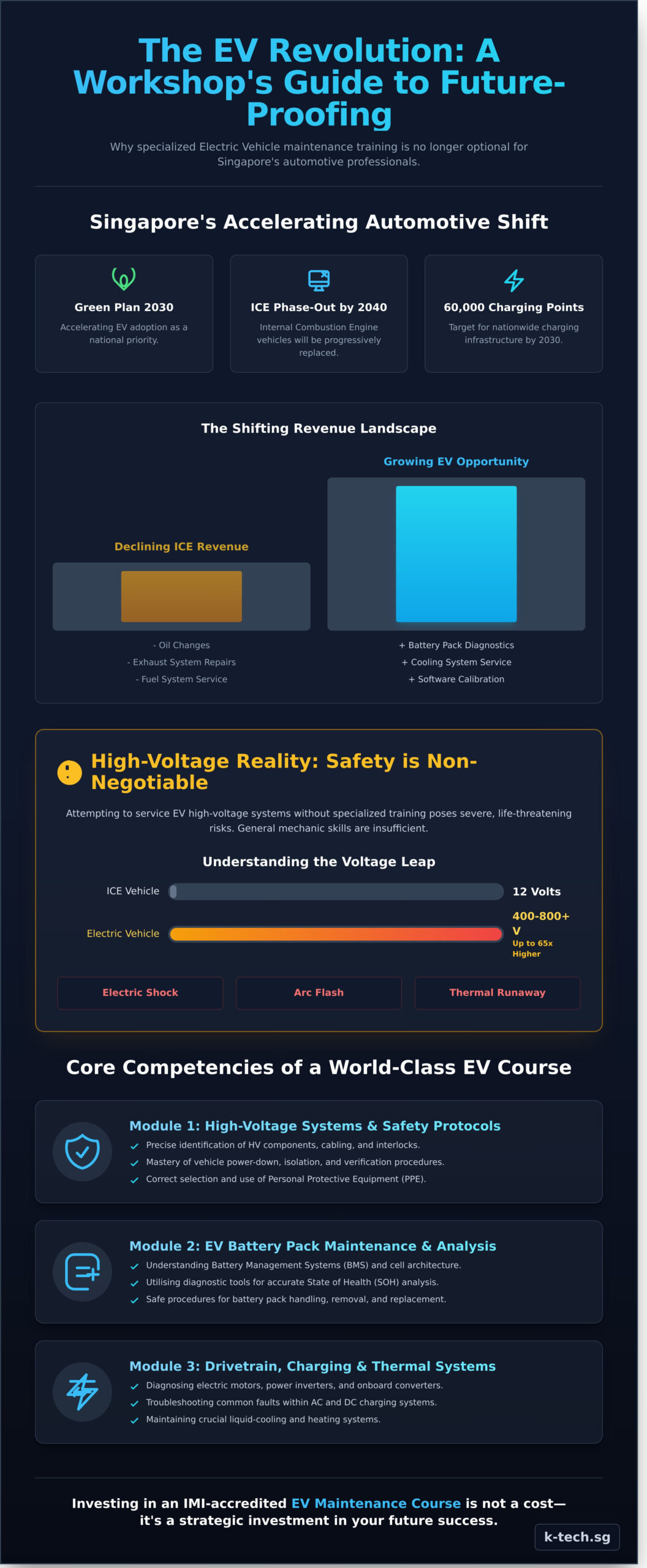
Singapore’s commitment to the Green Plan 2030 has accelerated EV adoption, with clear targets to phase out internal combustion engine (ICE) vehicles by 2040 and deploy 60,000 charging points by 2030. This transition directly impacts workshop revenue streams, as the routine servicing needs of ICE vehicles-such as oil changes and exhaust system repairs-will steadily decline. Conversely, specialized EV maintenance tasks, including battery pack diagnostics, cooling system service, and software calibration, represent a higher-value service category. Investing in a professional ev maintenance course is a strategic move to capture this growing, high-margin market segment and ensure long-term business viability.
High-Voltage Systems: The Safety Imperative
The most critical distinction between ICE vehicles and EVs is the presence of high-voltage (HV) battery systems, typically operating between 400 and 800 volts. Attempting to service these systems without specialized training poses severe, life-threatening risks, including electric shock, arc flash, and thermal runaway. The complexity of modern electric vehicle technology demands a fundamentally different skill set. General mechanic skills are inadequate for safely diagnosing and repairing these advanced electrical architectures. Adherence to stringent safety protocols, the correct use of Personal Protective Equipment (PPE), and proficiency with insulated tools are non-negotiable safety requirements that can only be mastered through formal, accredited training.
Ultimately, the EV transition is reshaping the automotive repair industry. Workshops that fail to adapt risk obsolescence, while those that invest in enhancing their technical capabilities will thrive. A comprehensive ev maintenance course is the foundational step for any technician or business owner aiming to lead in this new automotive ecosystem, turning a potential threat into a significant business opportunity.
Core Competencies of a Professional EV Maintenance Course
A truly effective ev maintenance course moves beyond theoretical knowledge to build tangible, workshop-ready skills. The curriculum must be structured to develop not just understanding, but deep operational proficiency through hands-on practical training. By simulating real-world diagnostic and repair scenarios, technicians gain the critical experience needed to service complex electric vehicle systems safely and efficiently. The ultimate objective is to cultivate technician confidence and competence, ensuring they can manage the unique challenges presented by high-voltage automotive technology. This structured approach mirrors the importance placed on workforce development by initiatives like the government-backed training programs designed to prepare industries for technological transitions.
Module 1: High-Voltage Systems and Safety Protocols
Safety is the foundational pillar of any professional ev maintenance course. This module provides technicians with the essential knowledge to operate safely in a high-voltage environment. Mastering these protocols is non-negotiable for preventing personal injury and vehicle damage. Core competencies include:
- Precise identification of high-voltage components, cabling, and safety-interlock systems.
- Mastery of vehicle power-down, isolation, and verification procedures.
- Correct selection and application of personal protective equipment (PPE).
- Understanding emergency response protocols for high-voltage incidents and thermal events.
Module 2: EV Battery Pack Maintenance and Analysis
The high-voltage battery is the heart of an EV. This module delivers specialized training on the architecture, diagnostics, and handling of these advanced energy systems. Technicians will develop the skills to assess and maintain the vehicle’s most critical and high-value component. Key learning outcomes involve:
- Understanding battery cell chemistry, module architecture, and Battery Management Systems (BMS).
- Utilising advanced diagnostic tools for accurate battery State of Health (SOH) analysis.
- Executing safe and systematic procedures for battery pack handling, removal, and replacement.
- An introduction to advanced concepts such as cell balancing and module-level repair.
Module 3: Drivetrain, Charging, and Thermal Systems
Beyond the battery, a comprehensive course must cover the integrated systems that enable EV operation. This module focuses on the diagnosis and maintenance of the electric drivetrain, charging infrastructure, and crucial thermal management systems that protect high-voltage components. Technicians will learn to:
- Diagnose and service electric motors, power inverters, and onboard converters.
- Troubleshoot common faults within AC and DC charging systems and related components.
- Maintain the crucial liquid-cooling and heating systems that regulate battery and cabin temperature.
- Analyse the operation and performance of regenerative braking systems.
Choosing the Right Certification: IMI vs. Local Accreditations
In the rapidly advancing automotive industry, not all certifications carry the same weight. For technicians seeking to specialize in electric vehicles, understanding the distinction between local and international standards is paramount. While local accreditations, such as the government-recognized National EV Specialist Safety (NESS) Certification, establish a crucial baseline for safe practice within Singapore, an internationally recognized qualification offers a different scope of advantages. The choice of certification directly impacts a technician’s professional credibility, career mobility, and the operational standing of their workshop.
What is the Institute of the Motor Industry (IMI)?
The Institute of the Motor Industry (IMI) is the leading professional body for the global automotive sector. Headquartered in the UK, the IMI sets and maintains rigorous standards for technical training, assessment, and professional conduct. An IMI qualification is not just a certificate; it is an internationally portable credential that signifies a technician has been trained to a globally recognized benchmark of excellence, ensuring their skills are transferable across markets.
Benefits of an IMI-Accredited EV Qualification
Pursuing an IMI-accredited ev maintenance course provides distinct strategic advantages for both individual technicians and the automotive businesses they represent. This level of certification is a clear indicator of a commitment to the highest professional standards, enhancing workshop credibility with customers, fleet operators, and insurance providers who prioritize safety and quality.
- Demonstrates Adherence to Global Standards: Confirms that technicians possess technical capabilities aligned with international best practices for high-voltage vehicle systems.
- Enhances Workshop Credibility: Builds trust with clients and industry partners, providing a significant competitive edge in a sophisticated market.
- Provides a Clear Career Pathway: IMI qualifications are structured to support progressive career development, from foundational safety levels to advanced diagnostic skills.
- Ensures Curriculum Relevancy: The content of an IMI-approved ev maintenance course is continuously updated to reflect the latest technological advancements and safety protocols in the global EV sector.
Integrating Training with Advanced EV Diagnostic Tools
Effective electric vehicle maintenance is fundamentally reliant on the proficient use of sophisticated diagnostic equipment. The complex, high-voltage systems in modern EVs demand a level of analysis that goes far beyond traditional OBD2 capabilities. A comprehensive ev maintenance course must therefore bridge the critical gap between theoretical knowledge and practical application, ensuring technicians are not just familiar with but are experts in operating the advanced tools that define the modern workshop.
This integration is central to our training philosophy. We provide extensive hands-on time with industry-leading equipment, empowering technicians to confidently interpret complex data from battery analysers, high-voltage system scanners, and thermal imagers. This practical mastery is essential for accurate, safe, and efficient EV servicing.
The Role of OEM-Level EV Diagnostic Scanners
To service proprietary EV systems, technicians must move beyond basic code readers. Our training focuses on OEM-level diagnostic tools, such as the Autel MaxiSys EV series, which provide unparalleled access to the vehicle’s core electronic architecture. This allows for deep, specific analysis and control.
- Deep Battery Pack Analysis: Go beyond State of Health (SOH) to analyse individual cell voltages, temperature variations, and module balance for precise fault identification.
- Component Activations and Calibrations: Perform critical functions like activating battery coolant pumps, calibrating sensors, and performing system initialisations after a component replacement.
- Live Data Streaming: Read and interpret live data streams from the Battery Management System (BMS), inverter, onboard charger, and other EV-specific control modules to diagnose intermittent issues.
Why Hands-On Tool Training Matters
Theoretical learning alone is insufficient for developing true diagnostic competence. Our hands-on approach within this ev maintenance course builds the muscle memory and confidence required for high-stakes electrical diagnostics. This direct experience significantly reduces diagnostic time, improves first-time fix rates, and ensures your workshop can maximise its return on investment in advanced equipment. By empowering your technicians with these skills, you enhance your workshop’s operational efficiency and service capability.
Equip your team with the skills to master these essential systems. Explore the advanced Autel EV diagnostic tools we integrate into our professional training programmes.
K-Tech’s IMI-Accredited EV Training: Your Path to Expertise
In Singapore’s rapidly evolving automotive landscape, specialized expertise is no longer an advantage-it is a necessity. K-Tech Auto Solution provides the definitive pathway for technicians to master electric vehicle technology. As an IMI Approved Training Centre, our programmes are designed and delivered by industry experts to meet the highest global standards. We offer a structured, end-to-end training solution that transforms foundational knowledge into professional, certified competence.
Our commitment to practical excellence is demonstrated through our hands-on training methodology. Participants gain direct experience with the latest Autel EV diagnostic equipment, working on dedicated training rigs and live vehicles. This approach ensures that theoretical concepts are immediately applied in a real-world workshop environment. K-Tech provides a clear progression, from essential safety protocols to advanced battery diagnostics and repair, making our ev maintenance course the most comprehensive in the market.
Course Structure and Learning Environment
Our training ecosystem is engineered for maximum learning efficiency and skill retention. We deliver a superior educational experience by focusing on a professional, hands-on environment.
- Personalized Instruction: Small class sizes ensure every technician receives direct attention and guidance from our IMI-certified instructors.
- Blended Learning Model: We integrate intensive classroom theory with rigorous workshop practice, bridging the gap between knowledge and application.
- Advanced Training Facilities: Trainees get access to dedicated EV training vehicles, high-voltage battery modules, and cutting-edge diagnostic tools.
Who Should Enrol in This Course?
This professional development programme is tailored for individuals and organizations committed to leading the transition to electric mobility. Our curriculum is designed to meet the specific needs of:
- Automotive Technicians seeking to upskill and secure their careers in the growing EV sector.
- Workshop Owners and Managers investing in their team’s future to enhance service offerings and operational capabilities.
- Experienced Mechanics transitioning their expertise from traditional Internal Combustion Engine (ICE) vehicles to complex EV systems.
- Professionals aiming to achieve an internationally recognized IMI qualification to validate their advanced skills.
Partner with K-Tech to elevate your technical proficiency and become a leader in Singapore’s automotive future. To learn more about our structured learning pathways, explore the complete ev maintenance course details at k-tech.sg.
Elevate Your Expertise: The Definitive Path Forward in EV Maintenance
The transition to electric vehicles across Singapore is reshaping the automotive landscape, rendering specialized training an operational necessity. For technicians, proficiency in high-voltage systems and advanced diagnostics is no longer a niche skill but a core competency for career longevity and workshop safety. Choosing a globally recognized certification like IMI is paramount to validating your expertise and securing your position in this evolving sector.
K-Tech Auto Solution provides the definitive pathway to achieving this proficiency. As an Official IMI Approved Training Centre, our comprehensive ev maintenance course is designed to meet the highest international standards. Led by industry-certified experts, our curriculum integrates intensive, hands-on training with the advanced diagnostic capabilities of Autel tools, for which we are the exclusive Singapore distributor. This ensures our graduates are not just certified, but fully equipped for real-world challenges.
The future of automotive service is electric. We invite you to enquire about our IMI-Accredited EV Maintenance Course schedule and pricing and invest in your professional development. Partner with K-Tech to master the technology that will define the next generation of the automotive industry.
Frequently Asked Questions
What is the difference between IMI EV Levels 2, 3, and 4?
IMI EV Levels define progressive technician competency for electric vehicles. Level 2 covers routine maintenance and safety protocols for working around high-voltage systems. Level 3 advances to system de-energizing, re-energizing, and replacing high-voltage components. Level 4 represents the highest qualification, focusing on advanced diagnostics, testing, and repair of live high-voltage systems and battery packs. Each level builds upon the last, ensuring a structured development of technical capabilities for handling complex EV repairs safely.
Are there any prerequisites to enrol in the EV maintenance course?
Yes, specific prerequisites ensure participants have the foundational knowledge for success. Enrolment in our IMI Level 3 and 4 courses requires a minimum of two years of practical experience as a vehicle technician. A foundational understanding of automotive electrical systems and diagnostic procedures is essential. This requirement ensures all participants can fully engage with the advanced concepts and hands-on training, maximising the value of the certification for their professional development and workshop capabilities.
How long does the training take and what is the schedule?
The IMI EV Level 3 course is an intensive programme conducted over three full days, typically from 9:00 AM to 5:00 PM. This schedule is designed to provide a comprehensive blend of theoretical knowledge and extensive hands-on practical sessions. We maintain small class sizes to ensure personalised instruction and sufficient time with our advanced equipment. For specific course dates and availability, please refer to our official training calendar or contact our enrolment advisors for the latest schedule.
Is government funding, like SkillsFuture or CCP, available for this course?
Yes, our IMI-accredited ev maintenance course is eligible for government funding to support skills upgrading. Singapore Citizens and Permanent Residents can utilise their SkillsFuture Credit to offset course fees. Furthermore, companies sponsoring their technicians may be eligible for subsidies under various enterprise support schemes. We advise contacting our administration team, who can provide guidance and the necessary documentation to facilitate your funding application and ensure you maximise available subsidies for professional development.
What specific diagnostic equipment will I learn to use during the training?
Our training facility is equipped with industry-leading diagnostic technology. During the course, technicians will gain hands-on experience with advanced equipment such as the Autel MaxiSYS Ultra EV diagnostic scanner for comprehensive system analysis and topology mapping. You will also learn to operate specialised high-voltage tools, including CAT III/IV multimeters and insulation testers, which are critical for safely and accurately diagnosing faults in battery management systems (BMS) and high-voltage powertrain components.
How will this IMI certification benefit my workshop’s business?
Achieving IMI certification positions your workshop as a credible and qualified leader in the rapidly growing EV market. It provides customers with the assurance that their vehicles are serviced by technicians trained to the highest global standards, enhancing trust and brand reputation. This qualification expands your service offerings, allowing you to confidently handle complex EV repairs. This directly translates to increased revenue streams, improved operational efficiency, and a significant competitive advantage in the local automotive industry.
Do you offer training for hybrid vehicle maintenance as well?
Yes, our IMI-accredited training programmes cover both hybrid (HEV) and battery electric vehicles (BEV). The principles of high-voltage system safety, diagnostics, and component handling taught in our ev maintenance course are directly applicable to hybrid systems. The curriculum is designed to provide technicians with a comprehensive skill set to service the full spectrum of electrified vehicles, ensuring your workshop is fully equipped to meet the diverse needs of the modern automotive market.