The rapid proliferation of electric vehicles on Singapore’s roads presents a critical turning point for automotive workshops. Continuing with traditional service models risks operational obsolescence, while the complexity of high-voltage systems introduces significant technical and safety challenges. An incorrect investment in new equipment can be a costly misstep, leaving your business unprepared and uncompetitive. To secure sustainable growth, workshops must strategically embrace this technological evolution, and the foundation of this transition is a comprehensive suite of advanced EV diagnostic tools for workshops.
This essential guide provides a clear, strategic roadmap for workshop owners and lead technicians. We will detail the critical capabilities of professional EV diagnostic systems, from advanced battery pack analysis to high-voltage component testing and system calibration. Furthermore, this article will explore the complete ecosystem of equipment required beyond a simple scanner, enabling you to formulate a clear plan to get your workshop ‘EV-ready’. By understanding these core requirements, you can confidently justify the investment in SGD, enhance operational efficiency, and unlock profitable new revenue streams in Singapore’s expanding EV service market.
Key Takeaways
- Understand why traditional diagnostic equipment is fundamentally insufficient for the complex electronic architecture and unique high-voltage systems in modern electric vehicles.
- Discover the essential capabilities of professional EV diagnostic tools for workshops, moving beyond basic fault codes to encompass comprehensive system analysis and specialized battery pack testing.
- Learn how to build a complete EV service ecosystem, integrating advanced equipment with certified technical training and safety protocols to ensure operational efficiency and profitability.
- Gain a clear framework for selecting the right EV diagnostic partner in Singapore by evaluating long-term value, ongoing technical support, and industry-recognised training.
Why Traditional Diagnostic Tools Are Insufficient for Electric Vehicles
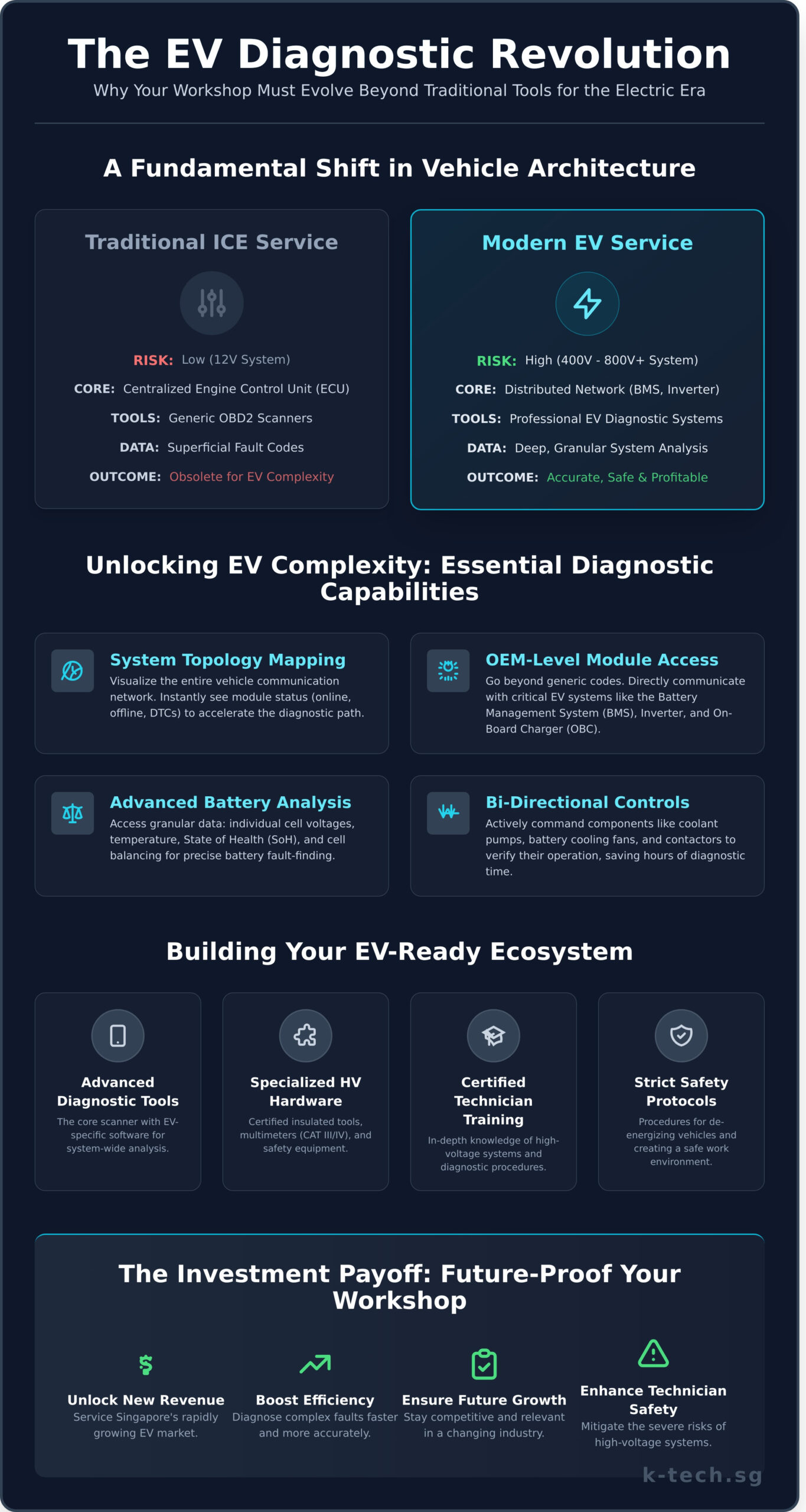
The transition from internal combustion engines (ICE) to electric vehicles (EVs) represents a fundamental paradigm shift in automotive technology. Consequently, the diagnostic methodologies that have served workshops for decades are no longer adequate. While the standardized On-Board Diagnostics (OBD) port remains, generic OBD2 scanners can only access a superficial layer of data, leaving technicians blind to the complexities of an EV’s integrated systems. To maintain operational efficiency and service quality, workshops must invest in advanced EV diagnostic tools for workshops specifically engineered for this new electric architecture.
Beyond the Engine Control Unit (ECU): A New Architecture
Unlike an ICE vehicle centered around an Engine Control Unit (ECU), an EV operates on a distributed network of specialized high-voltage modules. Key components such as the Battery Management System (BMS), the Inverter, and the On-Board Charger (OBC) communicate constantly over a complex Controller Area Network (CAN bus). Traditional tools cannot interpret this sophisticated digital language, making it impossible to accurately diagnose faults or access performance data from these critical systems.
The Central Role of the Battery Management System (BMS)
The Battery Management System (BMS) is the central intelligence of the EV’s high-voltage battery pack. Its responsibilities are critical for vehicle performance, longevity, and safety. These functions include:
- Monitoring individual cell voltage and temperature
- Calculating State of Charge (SoC) and State of Health (SoH)
- Balancing cells to ensure uniform degradation
- Controlling the charging and discharging processes
Accessing this granular data is non-negotiable for diagnosing battery-related issues, from cell degradation to thermal management faults. This level of interrogation is exclusively available through professional EV diagnostic tools designed for modern workshops.
High-Voltage Systems and Safety Imperatives
Perhaps the most critical distinction is the operational voltage. Technicians are accustomed to the low-risk 12V systems of ICE vehicles. In contrast, EVs operate at extremely high voltages, typically ranging from 400V to over 800V. Using standard, uninsulated tools on these systems poses a severe risk of life-threatening electrical shock and can cause catastrophic damage to sensitive electronic components. A professional approach mandates the use of certified insulated tools and strict adherence to high-voltage diagnostic safety protocols.
Core Capabilities of a Professional EV Diagnostic Scanner
To maximize operational efficiency, modern workshops must look beyond brand names and focus on the core functional capabilities of their diagnostic equipment. A professional-grade scanner provides a comprehensive, integrated view of the vehicle’s electronic ecosystem, moving far beyond isolated fault codes. These advanced capabilities are not luxuries; they are essential for enabling technicians to diagnose complex issues with greater speed and accuracy. Investing in the right features for your EV diagnostic tools for workshops directly translates to higher vehicle throughput and increased profitability.
Comprehensive System Topology Mapping
System topology mapping presents a visual schematic of all the vehicle’s control modules and their communication network status. Instead of chasing codes from one module to another, a technician can view the entire network on a single screen. This interface instantly highlights which modules are reporting Diagnostic Trouble Codes (DTCs), which are offline, and how they are interconnected, significantly accelerating the initial diagnostic pathway.
OEM-Level Access to All EV-Specific Modules
A fundamental differentiator from basic code readers is OEM-level access to all EV-specific control modules. Generic scanners often fail to communicate with critical systems like the Vehicle Control Unit (VCU), Motor Control Unit (MCU), Battery Management System (BMS), or the onboard Thermal Management system. Gaining access to these proprietary systems requires advanced hardware and software. Furthermore, this deep-level access must include bi-directional controls, which allow technicians to actively command components like coolant pumps or battery cooling fans to verify their operation. This advanced diagnostic process demands specialized tools and safety knowledge for EVs that standard equipment cannot deliver.
Advanced Battery Pack Analysis
Advanced battery pack analysis is a non-negotiable feature for any serious EV service centre. This capability involves reading and interpreting key high-voltage battery metrics, including State of Health (SOH) and State of Charge (SOC). A professional tool must be able to drill down further to display live data for individual battery cells or module blocks, such as voltage and temperature readings. This granular data is indispensable for performing accurate battery condition assessments, identifying weak or failing cells for potential repair, and providing documented evidence for warranty claims.
Essential Hardware for High-Voltage Battery Pack Diagnostics
While an advanced diagnostic scanner is the brain of your EV service operation, it cannot function alone. To safely and accurately diagnose high-voltage (HV) battery systems, workshops require a suite of specialized hardware. These tools form the physical interface between the technician and the complex battery architecture, ensuring precise measurements and safe handling protocols. Investing in this equipment is a non-negotiable step for any automotive business in Singapore serious about establishing its technical capabilities in the EV sector. This hardware is a cornerstone of a complete ecosystem of EV diagnostic tools for workshops.
The EV Diagnostics Box: Interfacing with the Battery
The EV diagnostics box serves as the critical bridge between your diagnostic scanner and the vehicle’s HV battery management system (BMS). This device facilitates direct communication, allowing technicians to bypass the standard OBD-II port to read granular data such as state of charge (SoC), state of health (SoH), individual cell voltages, and temperature readings. The Autel EVDiag Box is a prime example of this technology, providing comprehensive pack analysis when paired with a compatible MaxiSYS tablet.
Alongside specialized diagnostic tools, a modern workshop’s technological infrastructure often includes robust computing hardware and general electronics. For those sourcing supporting equipment, online retailers such as Tunewtec provide a broad selection of IT and electronic products that can complement a workshop’s primary diagnostic systems.
High-Voltage Insulation Testers (Megohmmeters)
An insulation tester, or megohmmeter, is an indispensable tool for safety and diagnostics. Its primary function is to detect current leakage by measuring the resistance of the insulation in high-voltage cables, motors, and components. This test is a critical safety check performed before and after any repair to prevent electric shock and thermal events. A comprehensive suite of EV diagnostic tools and workshop equipment must include a high-quality insulation tester, as it is also essential for diagnosing intermittent faults that standard scanners may miss.
Battery Cell and Module Testers
Advanced workshops can create significant value by moving beyond pack-level diagnostics to individual cell and module testing. Specialized testers allow technicians to assess the health of cells or modules that have been removed from the battery pack. This capability is fundamental for identifying weak or failing cells for targeted replacement, enabling battery pack refurbishment. Offering this service provides a cost-effective alternative to a full pack replacement, establishing a new and profitable revenue stream for your business.
Building a Complete EV Service Ecosystem in Your Workshop
Acquiring advanced EV diagnostic equipment is a critical investment, but it represents only one component of a successful strategy. To truly excel in the electric vehicle market, workshops must cultivate a complete service ecosystem-an integrated framework of technology, training, and safety protocols. This holistic approach moves beyond simple repairs, positioning your business as a future-ready service centre. An integrated ecosystem ensures superior operational efficiency, upholds the highest safety standards, and builds the two most valuable assets in this industry: technician confidence and customer trust.
The Critical Role of Certified Technician Training
Advanced diagnostic tools are only as effective as the technicians operating them. Proper training is non-negotiable, particularly concerning high-voltage systems where safety is paramount. Certifications from globally recognized bodies like the Institute of the Motor Industry (IMI) serve as a benchmark for quality and competence, assuring clients that your team possesses the specialized skills required for safe and accurate EV servicing. Learn about K-Tech Auto Solution’s IMI-accredited EV technician courses.
Essential Safety and Ancillary Equipment
A comprehensive safety infrastructure is fundamental to any EV service operation. This extends beyond the diagnostic scanner to include a range of specialized ancillary equipment. Establishing a dedicated and clearly marked EV service bay is the first step, which must be equipped with essential gear to ensure compliance and protect your technicians. Key items include:
- High-voltage insulated hand tools (VDE certified)
- Class 0 electrical safety gloves and protective gear
- Specialised battery lifting tables and support systems
- Appropriate safety signage and bay demarcation equipment
Software Updates and Ongoing Technical Support
The EV landscape evolves at an accelerated pace, with new models, battery technologies, and software systems introduced continuously. The best EV diagnostic tools for workshops are those supported by regular, comprehensive software updates. This ensures your equipment remains relevant and capable of servicing the latest vehicles. Furthermore, access to reliable, local technical support from a trusted partner like K-Tech Auto Solution is invaluable for resolving complex diagnostic challenges, minimising vehicle downtime and maximising workshop productivity.
Choosing the Right EV Diagnostic Partner for Your Workshop in Singapore
Selecting the right EV diagnostic tools for your workshop is a strategic decision that extends far beyond the initial purchase price. It is an investment in your workshop’s future capabilities, operational efficiency, and long-term profitability in Singapore’s rapidly evolving automotive landscape. A comprehensive evaluation framework is essential to ensure you are not just buying a tool, but forging a partnership that supports sustainable growth.
Evaluating Hardware and Software Capabilities
Your assessment must begin with the core technical specifications. Seek out robust hardware built for demanding workshop environments and a powerful Vehicle Communication Interface (VCI) that supports advanced protocols like J2534 pass-thru. Critically, evaluate the software’s vehicle coverage, ensuring it offers in-depth diagnostic capabilities for popular EV models on Singapore’s roads, including BYD, Tesla, Hyundai, and Kia. Opting for a modular solution allows for future upgrades, protecting your investment as technology advances.
The Value of a Local Distributor and Support Network
Purchasing equipment online may offer a lower initial cost, but it often lacks the essential support infrastructure. Partnering with an established local distributor like K-Tech provides tangible advantages. You gain access to hands-on demonstrations, a local warranty for swift service, and expert technical support from a team that understands the specific challenges and vehicle population of the Singaporean market. This local expertise is invaluable for troubleshooting complex issues and maximising the utility of your equipment.
Calculating Your Return on Investment (ROI)
Viewing this acquisition as a strategic investment reframes the entire decision. Advanced EV diagnostic tools for workshops unlock new, high-margin service offerings that were previously inaccessible. This directly enhances your revenue streams and positions your business as a market leader. Consider the new services you can provide:
- Battery State of Health (SOH) Reports: A crucial service for EV pre-purchase inspections and regular maintenance, commanding premium rates.
- High-Voltage Battery Pack Diagnostics: The ability to accurately diagnose battery faults, enabling component-level repairs or refurbishment.
- Increased Diagnostic Efficiency: Faster, more accurate fault finding reduces labour time per job, increasing overall workshop throughput and profitability.
Ultimately, the right partner provides more than just equipment; they deliver a comprehensive ecosystem of technology, training, and support. This integrated approach ensures your workshop is not only prepared for today’s EVs but is also positioned for success in the future of automotive service. To explore a complete automotive solution, visit k-tech.sg.
Your Strategic Partner in the EV Transition
The transition to electric mobility is not a future trend; it is a present reality for workshops across Singapore. As this guide has detailed, relying on traditional diagnostic equipment is no longer a viable strategy for servicing modern electric vehicles. True success in this evolving market demands a comprehensive approach-an integrated ecosystem combining advanced scanners, specialized high-voltage battery diagnostic hardware, and continuous professional development. Investing in the right EV diagnostic tools for workshops is the foundational step towards securing a competitive advantage and ensuring long-term operational excellence.
Choosing a partner is as critical as choosing the tools themselves. As the exclusive distributor of Autel in Singapore, K-Tech Auto Solution provides more than just state-of-the-art equipment. We deliver a complete, end-to-end technical solution designed for your growth. Our commitment to your success is fortified by our status as an IMI (UK) Accredited Technical Training Academy and backed by a dedicated local technical support team, ensuring you have the expertise and assistance required to excel.
Equip your workshop for the future. Explore our Autel EV Diagnostic Solutions.
Embrace the change with a trusted partner by your side and confidently drive your business towards sustainable growth in the new era of automotive technology.
Frequently Asked Questions About EV Diagnostic Tools
What is the main difference between a standard OBD2 scanner and a professional EV diagnostic tool?
A standard OBD2 scanner is designed primarily for internal combustion engine (ICE) vehicles, focusing on emissions-related and generic powertrain fault codes. In contrast, a professional EV diagnostic tool provides deep access to specialized high-voltage (HV) systems. This includes the Battery Management System (BMS), motor controller, onboard charger, and thermal management systems. It is engineered to interpret complex data such as battery state of health (SOH), cell balance, and insulation resistance, which is beyond the scope of any standard OBD2 device.
Do I need a different diagnostic tool for each EV brand like Tesla, BYD, or Hyundai?
Not necessarily. Advanced multi-brand diagnostic platforms, such as those from Autel, are engineered to provide extensive coverage for a wide range of EV manufacturers, including popular brands in the Singapore market like Tesla, BYD, and Hyundai. While some brands may have proprietary protocols requiring specific adapters or software modules for full functionality, a high-quality, versatile tool provides the most efficient and comprehensive solution for a workshop aiming to service multiple vehicle brands.
Is special training mandatory to use EV diagnostic tools safely and effectively?
While not a strict legal mandate in Singapore for tool operation alone, professional, IMI-accredited training is essential for technician safety and diagnostic competence. High-voltage systems present serious electrical hazards that require specialized knowledge to manage safely. Effective training ensures technicians can not only operate the equipment correctly but also accurately interpret the complex data from an EV’s systems. This commitment to professional development is crucial for delivering reliable service and protecting your staff.
How much should a workshop budget for a comprehensive EV diagnostic system?
In Singapore, a workshop should view this as a strategic investment in its technical capabilities. Professional-grade EV diagnostic tools for workshops can range from approximately S$4,000 for robust entry-level systems to over S$20,000 for advanced platforms. The final cost is determined by the system’s brand coverage, hardware capabilities such as battery pack analysis, included software subscriptions, and the level of technical support provided. This investment is fundamental for sustainable growth in the EV service sector.
What is a VCI (Vehicle Communication Interface) and why is it essential for modern diagnostics?
A Vehicle Communication Interface (VCI) is the essential hardware that connects the diagnostic tablet to the vehicle’s onboard computer systems. It functions as a translator, converting signals and data between the vehicle’s various Electronic Control Units (ECUs) and the diagnostic tool. For modern vehicles, a high-performance VCI is critical for ensuring stable, high-speed communication across advanced protocols like CAN FD and DoIP (Diagnostics over Internet Protocol), enabling accurate and efficient diagnostics.
Can these tools also diagnose hybrid vehicles, or are they only for fully electric cars?
Professional EV diagnostic systems are comprehensive solutions designed with full support for hybrid electric vehicles (HEVs) and plug-in hybrid electric vehicles (PHEVs). These advanced platforms are equipped to diagnose the entire vehicle ecosystem, including both the high-voltage battery and electric motor components as well as the internal combustion engine. This dual capability ensures your workshop can efficiently service the complete spectrum of electrified vehicles, maximizing your operational readiness and market opportunity.