The decision to integrate Advanced Driver-Assistance Systems (ADAS) services into your workshop represents a significant capital investment and a critical step towards future-proofing your business. For automotive leaders in Singapore, navigating the complex market of adas calibration equipment can be a formidable challenge, fraught with concerns over technological obsolescence, return on investment, and operational integration. A misstep can lead to substantial financial loss and a missed opportunity to secure a competitive advantage in a rapidly evolving industry.
This definitive buyer’s guide is designed to eliminate that uncertainty. We provide a comprehensive framework to empower workshop owners and managers to make an informed, strategic decision. This article moves beyond simple feature comparisons to deliver a clear pathway for evaluating total cost of ownership, ensuring your chosen system enhances operational efficiency, and maximizing your long-term profitability. By following this guide, you will gain the confidence to select a future-proof solution that establishes your workshop as a leader in advanced vehicle repair technology.
Key Takeaways
- Learn to assess a complete ADAS calibration system, understanding how core components like diagnostic scanners, software, and alignment tools integrate for a seamless workflow.
- Evaluate potential adas calibration equipment based on critical decision factors that directly impact your workshop’s operational efficiency, accuracy, and profitability.
- Identify the non-negotiable workshop requirements, from bay dimensions to lighting conditions, that are mandatory for performing OEM-standard calibrations in Singapore.
- Understand why comprehensive technical training and robust supplier support are critical investments that maximise the long-term value of your hardware.
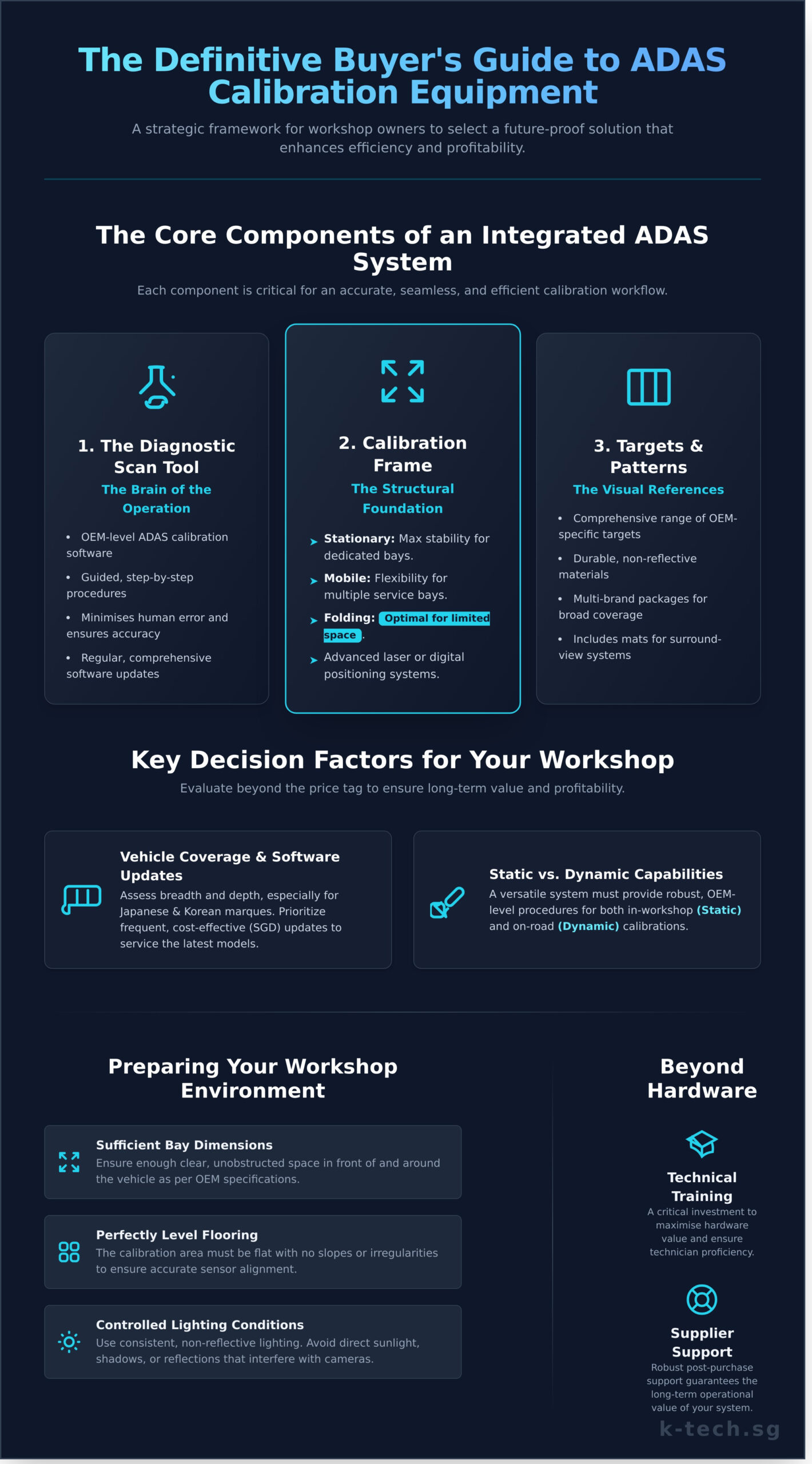
The Core Components of a Professional ADAS Calibration System
Investing in professional adas calibration equipment requires understanding that a complete system is far more than a standalone frame and a few targets. It is an integrated ecosystem where each component performs a critical function in a precise workflow. To achieve the OEM-level accuracy demanded by modern Advanced Driver-Assistance Systems (ADAS), these components must communicate and work together seamlessly. A failure in one part compromises the entire calibration, risking vehicle safety and workshop reputation. This integrated approach ensures maximum operational efficiency and guarantees precise, repeatable results.
The Diagnostic Scan Tool: The Brain of the Operation
The diagnostic scan tool is the central command unit of any ADAS calibration setup. It is imperative to select a tool with OEM-level ADAS calibration software that provides guided, step-by-step procedures and clear on-screen instructions. This minimises human error and ensures adherence to manufacturer specifications. Furthermore, given the rapid evolution of vehicle technology, regular and comprehensive software updates are non-negotiable. Leading brands, such as Autel, are globally recognized for their extensive ADAS capabilities and consistent software support, providing workshops with the confidence to service a wide range of vehicles.
Calibration Frame and Positioning System
The physical frame is the structural foundation for positioning calibration targets with absolute precision. The choice of frame directly impacts workshop workflow and space utilisation. Key types include:
- Stationary Frames: Ideal for dedicated ADAS bays, offering maximum stability.
- Mobile Frames: Provide flexibility to perform calibrations in different service bays.
- Folding Frames: The optimal solution for workshops in Singapore with limited space, allowing for easy storage.
Positioning accuracy is achieved through advanced laser or digital systems that guide the technician in setting the frame correctly relative to the vehicle’s centerline. An intuitive and precise setup process is crucial for reducing service times and ensuring accurate calibrations.
Targets, Patterns, and Reflectors
Targets, patterns, and reflectors are the visual references that vehicle cameras and sensors use to recalibrate. A professional set of adas calibration equipment must include a comprehensive range of OEM-specific targets to service the diverse vehicle market. Workshops can choose between multi-brand target packages for broad coverage or single-brand kits for specialization. These components must be manufactured from durable, non-reflective materials to withstand daily workshop use and prevent erroneous readings. The system should also include specialised mats for calibrating surround-view and rear camera systems.
Key Decision Factors When Selecting ADAS Equipment
Investing in ADAS calibration equipment is a significant commitment that extends far beyond the initial purchase price. The true value of a system is measured by its impact on your workshop’s operational efficiency, service accuracy, and long-term profitability. A forward-thinking decision requires a comprehensive evaluation of the system’s core capabilities and its alignment with your specific business needs. The right choice will empower your technicians, expand your service offerings, and solidify your reputation for quality.
Vehicle Coverage and Software Updates
The primary measure of any ADAS system is its vehicle coverage. Assess not only the breadth of manufacturers supported but also the depth of coverage for models commonly found on Singapore’s roads, including popular Japanese and Korean marques. As vehicle technology evolves rapidly, consistent software updates are non-negotiable. An outdated system quickly becomes a liability. Therefore, it is critical to inquire about the frequency, delivery method, and ongoing costs (e.g., annual subscription fees in SGD) of software updates to ensure your investment remains relevant and capable of servicing the latest vehicles.
Static vs. Dynamic Calibration Capabilities
Modern workshops must be equipped to perform both static and dynamic calibrations to provide comprehensive service. Static calibrations are performed in a controlled workshop environment using specific targets and patterns, while dynamic calibrations require an on-road driving procedure guided by a diagnostic scan tool. While some systems may excel at one type, a truly versatile solution will offer robust, OEM-level procedures for both. Evaluate how the system’s diagnostic interface manages and documents dynamic procedures, as this is crucial for verification and quality assurance.
Integration with Other Workshop Systems
Operational efficiency is maximised when your adas calibration equipment integrates seamlessly with other core workshop systems. The most critical link is with your wheel alignment equipment, as an accurate vehicle thrust line is a prerequisite for many ADAS calibrations. Systems designed to work in concert with your existing aligner create a unified workflow, drastically reducing setup times, minimising the potential for error, and ensuring procedural accuracy. This level of system integration is a key driver of productivity and profitability in a high-volume workshop environment.
Before committing, ensure you ask potential suppliers these critical questions:
- What is the annual cost of software licensing and updates in SGD?
- Does your system provide comprehensive coverage for the top vehicle brands in the Singapore market?
- How does the equipment integrate with our current wheel alignment system?
- What level of technical support and training is included with the purchase?
Preparing Your Workshop Environment for ADAS Calibration
Investing in advanced adas calibration equipment is a critical step towards modernising your workshop’s capabilities. However, the precision of this technology is entirely dependent on the physical environment in which it operates. Overlooking these foundational requirements is a common and costly error, often leading to repeated failed calibrations, wasted labour hours, and diminished client trust. A properly prepared bay is not an optional extra; it is a non-negotiable prerequisite for achieving the accuracy demanded by vehicle manufacturers.
Space and Lighting Requirements
Accurate ADAS calibration requires a dedicated, controlled space free from physical and environmental interference. The area directly in front of the vehicle must be completely clear to allow for the precise placement of targets and to ensure an unobstructed line of sight for the vehicle’s sensors. Key environmental factors include:
- Sufficient Space: A typical bay requires a minimum clear area of approximately 10 metres in length by 5 metres in width. This provides adequate room for the vehicle, the calibration frame, and technician movement.
- Consistent Lighting: The calibration area must be equipped with uniform, non-reflective lighting. Avoid areas with direct sunlight, shadows, or fluctuating light sources, as these can disrupt camera-based sensors and lead to inaccurate readings.
The Critical Role of a Level Floor
An unlevel floor is one of the most significant contributors to ADAS calibration failure. Vehicle manufacturers have stringent specifications for floor levelness, as even minor deviations across the bay can alter the vehicle’s ride height and sensor angles, corrupting the entire calibration process. This focus on precision is reflected in industry-wide guidelines such as SAE International’s ADAS calibration standard, which underscores the need for verifiable conditions. While some advanced adas calibration equipment incorporates software for floor level compensation, a physically level surface remains the professional standard. We strongly recommend a professional assessment of your workshop bay to guarantee it meets these essential criteria.
Ensuring your workshop meets these foundational requirements is the first step toward building a successful ADAS service division. With the right environment established, you can confidently explore our full range of advanced workshop equipment to build a comprehensive and efficient calibration setup.
Beyond Hardware: Training and Support as a Critical Investment
Selecting the right hardware is a foundational step, but the long-term profitability and success of your ADAS services depend on factors beyond the physical tool. The most advanced adas calibration equipment is only as effective as the technician operating it and the support system behind it. A strategic investment requires a holistic view, positioning training and ongoing support as integral components of your purchase, not as optional afterthoughts.
Why Certified Technician Training is Non-Negotiable
ADAS calibration is a task of immense precision, where minor errors can have significant safety consequences. Improper calibration not only compromises vehicle safety but also exposes your workshop to serious liability. This is why professional, certified training is essential. Accreditations, such as those from the Institute of the Motor Industry (IMI), validate a technician’s competency and ensure adherence to the highest industry standards. K-Tech offers comprehensive ADAS technician training programs designed to equip your team with the specialised skills required for accurate and safe calibrations.
Evaluating Supplier Support, Warranty, and Onboarding
Your equipment supplier should function as a strategic partner dedicated to your operational success. Before committing, evaluate the level of support provided. Is on-site setup and initial training included? Is there local technical support in Singapore available during your business hours to resolve issues quickly? A strong support partner with a clear warranty on all hardware components is critical to minimizing downtime, ensuring your investment consistently generates revenue and enhances your workshop’s operational efficiency.
Calculating the Total Cost of Ownership (TCO)
The sticker price of your adas calibration equipment is only one part of the total financial picture. A comprehensive TCO calculation provides a more realistic understanding of the investment. Factors to consider include:
- Initial Purchase Price: The upfront cost of the hardware, which can range from S$20,000 to over S$50,000 for professional systems in Singapore.
- Ongoing Costs: Software subscriptions for vehicle updates, and the purchase of specific vehicle targets or patterns.
- Ancillary Costs: Fees for technician training and certification, as well as potential workshop modifications like a dedicated, level bay.
By offsetting these costs against the potential revenue from providing in-demand calibration services, you can build a sustainable and profitable business model. Learn more about K-Tech’s complete ADAS calibration solutions to understand how a comprehensive package can maximise your return on investment.
Future-Proof Your Workshop with the Right ADAS Solution
Selecting the right ADAS solution is a pivotal decision that extends beyond the initial hardware purchase. As this guide has outlined, a comprehensive evaluation must consider the system’s core components, your specific workshop environment, and the critical role of professional training and ongoing support. The correct adas calibration equipment is a strategic investment in your workshop’s future, enhancing your technical capabilities and ensuring long-term operational efficiency.
At K-Tech Auto Solution, we provide more than just equipment; we deliver integrated, end-to-end workshop solutions. As the exclusive Singapore distributor for Autel and an IMI (UK) accredited Technical Training Academy, we are uniquely positioned to be your strategic partner in advancing your service offerings. We are committed to empowering your team with the technology and expertise required to excel.
Allow our specialists to help you navigate this critical investment with confidence. Request a consultation on the right ADAS solution for your workshop and position your business for sustainable growth in the evolving automotive landscape.
Frequently Asked Questions About ADAS Calibration Equipment
How much space do I really need for an ADAS calibration setup?
To ensure OEM-level accuracy, a dedicated bay of approximately 10 metres by 5 metres is recommended. This space must be perfectly level, with non-reflective flooring and controlled lighting to avoid sensor interference. The area directly in front of the vehicle must remain clear of obstructions during the calibration. For workshops in Singapore with space constraints, certain advanced mobile systems offer greater layout flexibility without compromising on precision, thereby enhancing operational efficiency.
What is the average ROI for investing in ADAS calibration equipment?
The return on investment for ADAS calibration equipment is substantial for workshops in Singapore. With average calibration services priced between S$250 and S$600, a workshop performing just a few calibrations per week can expect a payback period of 12 to 18 months. This investment not only generates a new, high-margin revenue stream but also positions your business as a forward-thinking leader capable of servicing the growing population of modern, technologically advanced vehicles.
Can I use my existing diagnostic scan tool with a new ADAS frame?
Compatibility depends on the specific brands of your diagnostic scan tool and the ADAS frame. While some manufacturers design their systems to work exclusively together, others offer broader compatibility. For optimal workflow and technical capability, we recommend an integrated solution where the scan tool and frame are designed for seamless system integration. It is crucial to verify compatibility with your equipment provider to ensure accurate data transfer and prevent procedural errors during calibration.
How often are new vehicle models and calibration targets added to the software?
Leading manufacturers of professional ADAS systems provide frequent software updates, typically on a monthly or bi-monthly basis. These updates are critical for expanding vehicle coverage to include the latest models, introducing new calibration targets, and refining existing procedures. Maintaining an active software subscription is essential for any workshop to ensure its technical capabilities remain current and can service the newest vehicles entering the Singapore automotive ecosystem, ensuring long-term operational relevance.
What happens if a calibration is performed incorrectly?
An incorrectly performed calibration poses a significant risk to vehicle safety and workshop liability. It can lead to the malfunctioning of critical safety systems like Autonomous Emergency Braking or Lane Keep Assist, resulting in potential accidents. This not only endangers the driver but also exposes the workshop to severe legal and financial repercussions. Proper training and the use of high-quality adas calibration equipment are fundamental requirements for ensuring vehicle safety and protecting your business’s reputation.
Is static or dynamic calibration more common for workshops to perform?
Static calibration, performed in a controlled workshop environment using specific targets and frames, is the more common and foundational service for independent workshops to offer. While dynamic calibration (requiring a road test) is also necessary for many vehicles, static procedures are often a prerequisite after component replacement, such as a windscreen or bumper. To understand the full scope of a modern windscreen replacement that necessitates this recalibration, you can check out Alt Autoglas for a detailed guide. Therefore, investing in static calibration capabilities is the primary step for a workshop aiming to provide comprehensive ADAS services.
How long does a typical ADAS calibration take with modern equipment?
With modern equipment, a typical static calibration can be completed efficiently. Including vehicle preparation, target setup, and the electronic scan process, most calibrations take between 30 and 75 minutes. The exact duration depends on the specific vehicle model, the complexity of the system being calibrated, and the technician’s proficiency. Advanced systems with digital setup instructions and precise laser positioning significantly enhance operational efficiency and reduce overall service time.