A comprehensive strategic guide for workshop owners and fleet managers to bridge the technical skills gap in EV, ADAS, and advanced diagnostics.
The 2026 Skills Gap: Why Specialized Automotive Training is Mandatory
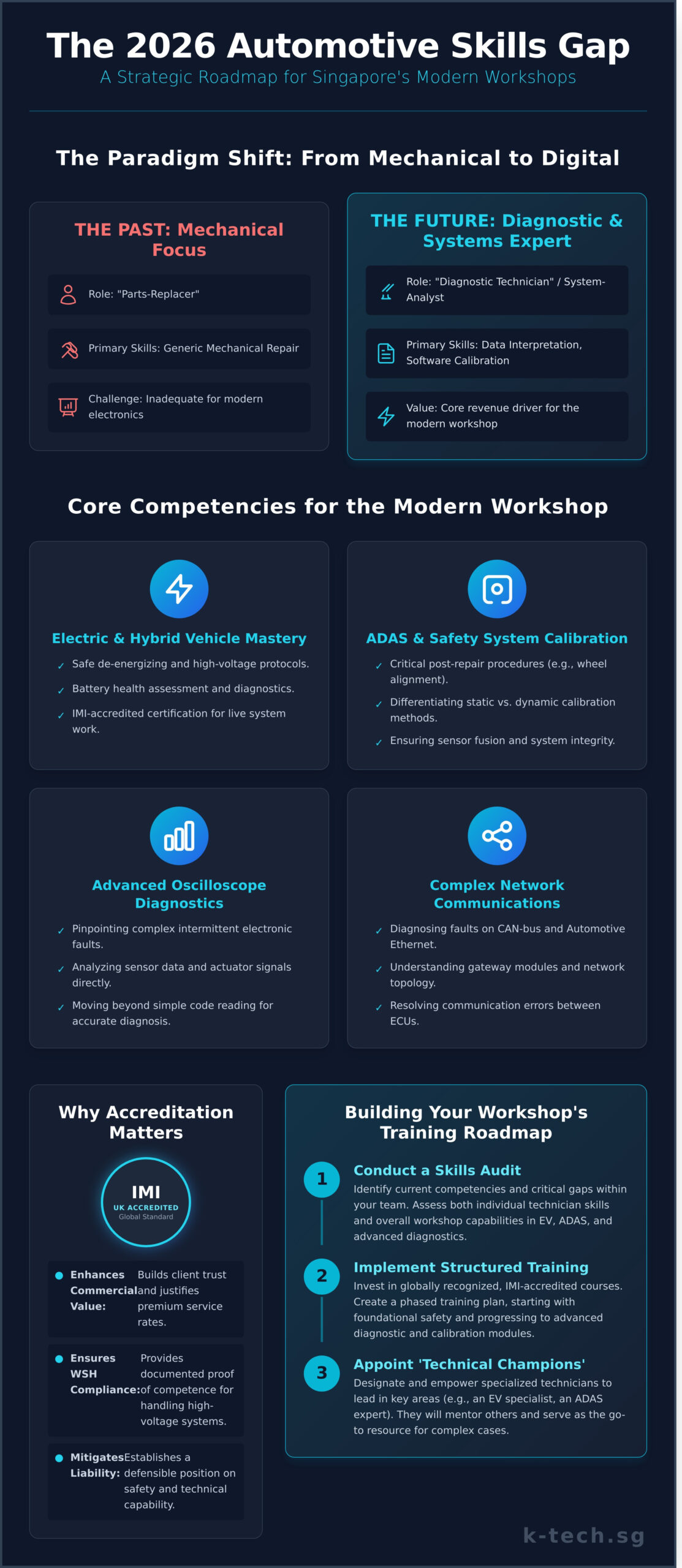
The automotive industry is undergoing its most significant transformation in a century. By 2026, a successful workshop will be defined not by the tools it owns, but by the technical proficiency of its staff. The rapid evolution from mechanical repairs to software-driven diagnostics demands a new breed of technician, equipped with skills that go far beyond traditional mechanics.
For workshops in Singapore and Malaysia, this shift is accelerated by national initiatives like the Singapore Green Plan 2030, which mandates a rapid transition to cleaner energy vehicles. This new landscape requires a fundamental upskilling strategy.
- The Technical Landscape: Modern vehicles are complex networks of computers on wheels. Expertise is now required in high-voltage systems, advanced driver-assistance systems (ADAS), and complex data network communications.
- The Diagnostic Shift: The most profitable work is no longer in replacing physical parts, but in accurately diagnosing intricate system-level faults. This requires advanced analytical skills and a deep understanding of vehicle software.
- Regulatory Impact: Government targets for EV adoption directly impact service requirements. Workshops must be certified and equipped to handle high-voltage systems safely and effectively to remain compliant and competitive.
- Skills Insufficiency: Generic mechanical knowledge is no longer sufficient. Without specialized automotive technical training courses, workshops risk being unable to service the majority of vehicles on the road, losing customers to authorized dealers.
The Rise of the "Diagnostic Technician"
The era of the "parts-fitter" is over. The modern workshop’s most valuable asset is the "Diagnostic Technician"—a professional who functions more like a system analyst than a traditional mechanic. They interpret complex data streams from diagnostic tools, understand the interplay between various electronic control units (ECUs), and pinpoint root causes of failure with precision. This data-driven approach dramatically reduces diagnostic time, prevents repeat repairs ("comebacks"), and builds customer trust. The Diagnostic Technician is the core revenue driver for the 2026 workshop.
Regulatory Drivers and Compliance in Singapore
Operating a modern workshop involves navigating a stringent regulatory environment. In Singapore, handling high-voltage EV systems is governed by strict Land Transport Authority (LTA) and Workplace Safety and Health (WSH) guidelines. Proper certification is not just a recommendation; it is a business necessity. For workshop owners, ensuring staff are professionally trained and certified directly mitigates professional liability and demonstrates a commitment to the highest safety standards.
Core Competencies: Essential Training Modules for Modern Workshops
To build a future-ready workshop, your team must master several core competencies. These training modules form the foundation of a modern, profitable automotive service operation.
- High-Voltage (HV) Systems: Comprehensive training in HV safety, de-energizing procedures, and battery health assessment for Electric and Hybrid Vehicles.
- ADAS Calibration: Understanding sensor fusion, target placement, and the precise procedures for radar, LiDAR, and camera alignment.
- Advanced Oscilloscope Diagnostics: Mastering waveform and signal analysis to accurately diagnose intermittent electronic faults that standard scan tools cannot detect.
- Network Communications: Gaining proficiency in troubleshooting vehicle networks, including CAN-bus, LIN, FlexRay, and Automotive Ethernet.
Electric and Hybrid Vehicle Mastery
As EVs and hybrids become commonplace, specialized training is non-negotiable. Our programmes, developed in partnership with leading institutions, cover multiple levels of competency, from basic safety awareness for all staff to advanced live-work certification for specialist technicians. A core focus is on essential safety protocols, ensuring your team can handle BEVs and PHEVs confidently and without risk. For more information on programmes co-certified with Temasek Polytechnic, explore our EV training modules.
ADAS and Safety System Calibration
Advanced Driver-Assistance Systems are now standard on most new vehicles. Any procedure that affects vehicle geometry, such as a windshield replacement, suspension repair, or wheel alignment, mandates a precise ADAS calibration. Without this, safety systems can malfunction, creating significant liability. Our training covers the critical technical differences between static and dynamic calibration, ensuring technicians can restore these complex systems to OEM standards. This proficiency is maximized when technicians are trained on the specific ADAS Calibration Systems they will use daily.
Accreditation Standards: The Value of Co-Certified Training with Temasek Polytechnic
In a rapidly evolving industry, the credibility of a technician’s certification is paramount. While various training options exist, a certification co-developed and accredited with a national institution like Temasek Polytechnic provides an unmatched level of quality, relevance, and industry recognition in Singapore.
This strategic partnership ensures that the curriculum is not only technically rigorous but also aligned with Singapore’s national standards and workforce development goals. For workshop owners, this translates directly into a higher standard of service and a significant competitive advantage.
- National Standard of Excellence: Temasek Polytechnic is a premier institution, and its involvement guarantees a curriculum that meets the highest educational and technical benchmarks.
- Commercial Value: Displaying a co-certified credential from a respected national polytechnic builds immediate trust with both individual clients and corporate fleet managers.
- Industry Alignment: The curriculum is designed in consultation with industry leaders to address the specific technical requirements of major OEMs and the local market.
The Quality Assurance of Standardized Training
A standardized, accredited training programme ensures that every technician on your team performs complex tasks with the same high level of competency. This consistency is the bedrock of a professional workshop’s reputation. The structured curriculum, developed with Temasek Polytechnic, covers theoretical knowledge and practical, hands-on application. Furthermore, the requirement for periodic re-certification ensures your team’s skills remain current, fostering a culture of continuous improvement and professional pride.
Market Differentiation for Independent Workshops
For independent workshops, accredited certification is a powerful tool to compete directly with authorized dealer service centers. It provides documented proof of technical competency, which is a key decision-making factor for customers. This is especially true for fleet operators, where industry trends show a strong preference for certified workshops when awarding service contracts, as it ensures compliance and minimizes vehicle downtime.
Implementation Strategy: Building a Workshop Training Roadmap
Effective upskilling requires a strategic plan, not just ad-hoc courses. A well-designed training roadmap minimizes operational disruption while maximizing the return on your investment.
- Conduct a Skills Audit: Assess the current technical proficiency of your team to identify specific knowledge gaps in areas like EV, ADAS, or advanced diagnostics.
- Identify "Technical Champions": Designate key technicians to become specialists in high-growth areas. This individual can become the in-house expert and mentor for the rest of the team.
- Create Phased Schedules: Implement a training schedule that rotates technicians, ensuring the workshop maintains daily throughput and service levels are not impacted.
- Integrate with Equipment Procurement: Align your training plan with new equipment purchases. Ensure that when you invest in advanced hardware like an Autel diagnostic suite, your team is immediately trained to leverage its full capabilities.
- Measure ROI: Track key metrics post-training. Measure the reduction in average diagnostic time, the decrease in comeback repairs, and the increase in revenue from new, high-value services.
Balancing Bench Time and Training Time
One of the biggest objections to training is the perceived loss of revenue from having a technician off the floor. This can be managed strategically. Consider sending technicians for off-site training during historically slower periods of the year. Another effective strategy is the "Train the Trainer" model, where your designated "Technical Champion" receives intensive training and is then responsible for disseminating that knowledge internally. In Singapore, workshop owners can also leverage government grants and SkillsFuture credits to significantly offset the costs of staff upskilling.
The Equipment-Training Synergy
Investing in Advanced Equipment without the corresponding training leads to chronic underutilization and a poor return on investment. An untrained technician may only use 20% of an advanced diagnostic tool’s capabilities, relying on basic code reading. In contrast, a certified technician who has undergone structured training can leverage 100% of the tool’s features—from running guided component tests to interpreting complex live data streams and performing system coding. This synergy between advanced hardware and expert training is what unlocks true diagnostic efficiency and profitability.
The K-Tech Academy: Your Partner in Technical Excellence
K-Tech’s Technical Training Academy is dedicated to elevating the capabilities of the automotive industry. We provide a B2B-focused approach, tailoring automotive technical training courses specifically for the needs of independent workshops, dealer groups, and commercial fleet operators.
Our training programmes, co-certified with Temasek Polytechnic, provide a mark of quality and industry recognition. Our methodology emphasizes hands-on learning, utilizing the latest Autel diagnostic and ADAS calibration hardware to ensure technicians are trained on the exact tools they will be using in a professional workshop environment.
Comprehensive Support Beyond the Classroom
Our commitment to your workshop’s success extends beyond the final day of the course. Graduates of our programmes gain access to ongoing technical advisory support to help with challenging real-world diagnostic problems. This creates a complete ecosystem where workshops are supported by best-in-class tools, training, and expert consultancy, ensuring your investment continues to deliver value long after the training is complete.
Starting Your Workshop’s Transformation
Building a future-proof workshop begins with a strategic investment in your team’s skills. The first step is a consultation with our technical advisors to assess your specific needs and develop a customized training package that aligns with your business goals.
Ready to prepare your workshop for 2026 and beyond? Enquire about our technical training programmes.
Frequently Asked Questions (FAQs)
What are the most essential automotive technical training courses for 2026?
The most critical courses focus on High-Voltage (HV) systems for EVs and hybrids, Advanced Driver-Assistance Systems (ADAS) calibration, and advanced diagnostic techniques using tools like an oscilloscope and network analysers. These three areas represent the fastest-growing and most profitable service opportunities.
How long does it take for a technician to complete a co-certified EV repair programme?
The duration varies depending on the certification level. Foundational safety awareness courses may take a few days, while advanced courses for diagnosing and repairing live high-voltage systems are more intensive and can span over a longer period with practical assessments.
Are there government subsidies available for automotive training in Singapore?
Yes, many of our automotive technical training courses are eligible for government support, including SkillsFuture Singapore (SSG) funding and other enterprise development grants. We can advise your business on the available schemes.
Can K-Tech provide customized training for large commercial fleet operators?
Absolutely. We specialize in creating bespoke training programmes for fleet operators and large organizations. We can tailor the curriculum to the specific vehicle makes and models in your fleet and even conduct training on-site at your facility.
Does my workshop need specialized equipment to participate in ADAS training?
While it is beneficial to have your own equipment, our training academy is fully equipped with the latest ADAS calibration systems from Autel. The hands-on portion of the course is conducted using our hardware, ensuring participants gain practical experience on industry-standard tools.
What is the difference between a mechanic and a certified diagnostic technician?
A traditional mechanic primarily focuses on the physical removal and replacement of parts. A certified diagnostic technician is a system analyst who uses advanced tools to interpret data, understand complex electronic interactions, and accurately pinpoint the root cause of a fault before any parts are replaced.
What is the benefit of a Temasek Polytechnic co-certified course over other training options?
A co-certification with a prestigious national institution like Temasek Polytechnic guarantees a high-quality, industry-recognized curriculum that is aligned with Singapore’s technical and educational standards. It offers a higher level of credibility and trust compared to non-accredited or purely private training certificates.
What happens if our workshop equipment is not from Autel; can we still attend training?
Yes. While our training is optimized for the Autel ecosystem we supply, the fundamental principles of diagnostics, EV safety, and ADAS calibration are universal. Technicians will gain core knowledge that is applicable across different equipment platforms.