The rapid evolution of vehicle technology, particularly the proliferation of Electric Vehicles (EVs) and Advanced Driver-Assistance Systems (ADAS) on Singapore’s roads, presents a significant challenge for independent workshops. Many now face the risk of losing business to dealerships or more technologically advanced competitors due to a growing skills gap. This technological shift demands a strategic investment in your team’s capabilities through professional technical training & certification, which has become a foundational component for sustainable growth and operational efficiency.
This comprehensive guide is designed to provide Singapore workshop owners and managers with a clear roadmap to success. Within this article, you will learn how to master the essential skills required for modern vehicle repair, understand the significant value of industry-recognised certification, and implement a training strategy that will future-proof your workshop. Equip your business to confidently service the latest vehicles, increase profitability through specialized services, and build a highly skilled, motivated technical team ready for the future of automotive care.
Key Takeaways
- The rapid transition to software-driven vehicles makes ongoing technical training a non-negotiable requirement for workshop survival and growth in Singapore.
- Identify the essential competencies for modern vehicle repair, including Electric Vehicle (EV) systems, Advanced Driver-Assistance Systems (ADAS) calibration, and complex diagnostics.
- Understand how industry-recognised technical training & certification validates your workshop’s expertise, building critical trust with both customers and insurance partners.
- Discover a practical framework for implementing a sustainable training program that effectively manages costs and minimises technician downtime.
The New Automotive Reality: Why Continuous Technical Training is Non-Negotiable
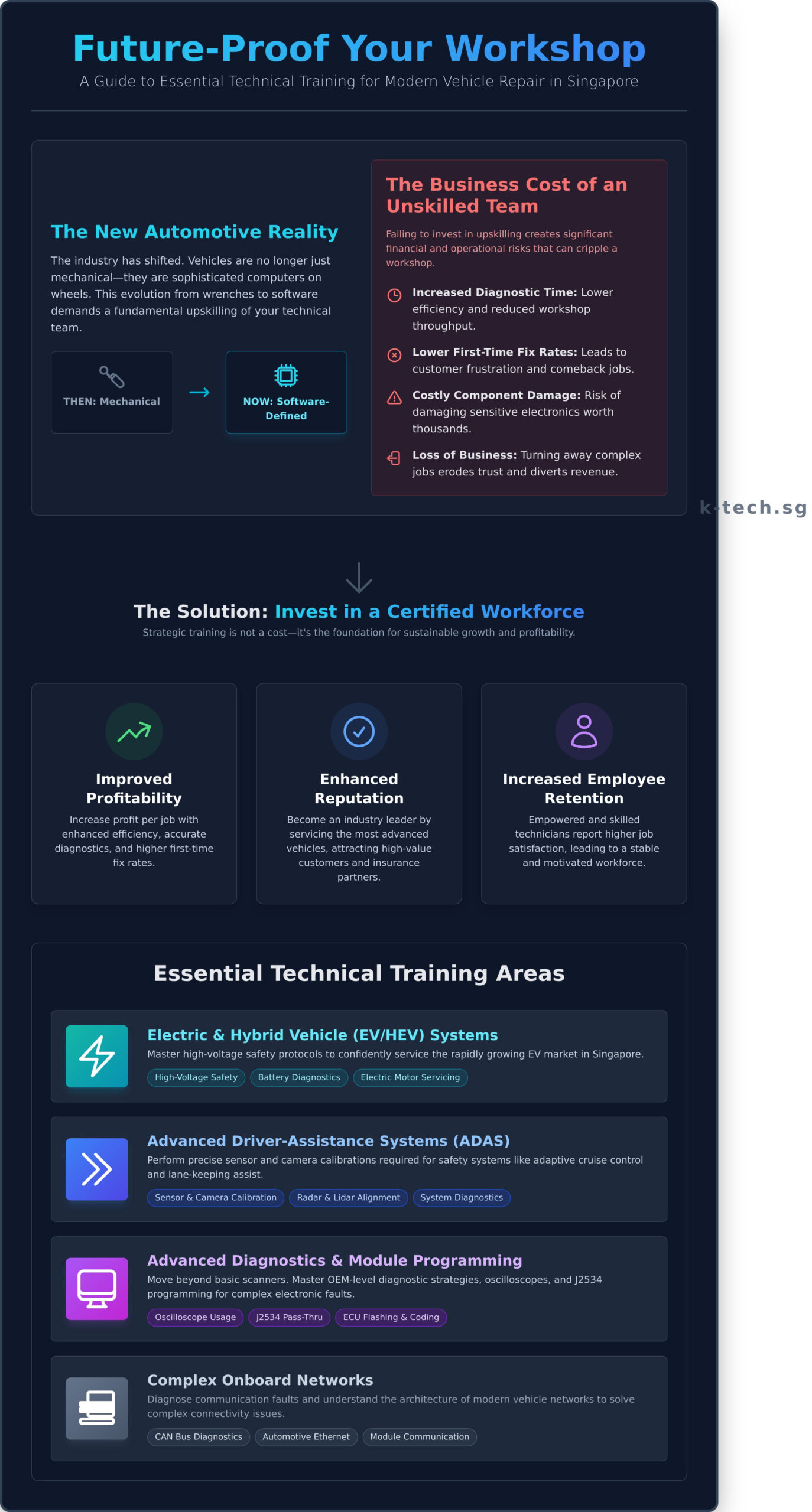
The automotive industry is experiencing its most profound transformation in over a century. The traditional, mechanically-focused landscape is rapidly being replaced by a sophisticated ecosystem of electronic controls, advanced software, and high-voltage systems. This new reality is not a future concept; it is present in workshops across Singapore today. The role of traditional automotive mechanics is fundamentally evolving, and skills that were once sufficient are now merely the foundation. To remain competitive and profitable, upskilling through continuous professional technical training & certification is no longer optional-it is an essential business survival strategy.
The Rise of Complex Vehicle Systems
Modern vehicles are effectively computers on wheels, integrating systems that demand specialized knowledge. The proliferation of Electric & Hybrid Vehicles (EV/HEV) introduces high-voltage battery diagnostics and electric motor servicing. Advanced Driver-Assistance Systems (ADAS) require precise sensor and camera calibration for functions like adaptive cruise control and lane-keeping assist. Furthermore, complex onboard networks using CAN bus and Automotive Ethernet mean technicians must now diagnose communication faults and perform module programming, tasks more aligned with IT than traditional mechanics.
The Business Cost of an Unskilled Team
Failing to invest in technician upskilling carries significant operational and financial risks. An unprepared team leads directly to increased diagnostic time, lower first-time fix rates, and reduced workshop throughput. The risk of inadvertently damaging a sensitive electronic control unit or ADAS sensor during a repair can result in costs exceeding thousands of Singapore Dollars (S$) for a single component. Ultimately, turning away complex jobs erodes customer trust and diverts a growing segment of high-value service revenue to better-equipped competitors.
Core Benefits of a Certified Workforce
Conversely, a strategic investment in a certified workforce delivers measurable returns and builds a foundation for sustainable growth. A team equipped with advanced diagnostic and repair capabilities operates with greater confidence and precision. This commitment to excellence translates into several core business advantages:
- Improved Profitability: Enhanced operational efficiency, accurate diagnostics, and higher first-time fix rates increase profitability per job.
- Enhanced Reputation: The ability to service the most advanced vehicles positions your workshop as an industry leader, attracting high-value customers.
- Increased Employee Retention: Empowered technicians report higher job satisfaction, leading to a stable, highly skilled, and motivated workforce.
Essential Technical Training Areas for the Modern Workshop
Understanding the need for continuous learning is the first step. The next is identifying the specific competencies that define a profitable, future-ready workshop. The curriculum for a modern technician has expanded far beyond foundational mechanics, which are well-covered by qualifications like the ITE Nitec in Automotive Technology. Mastery in the following high-demand areas is no longer optional; it is the cornerstone of advanced diagnostics, high-margin repairs, and long-term business sustainability in Singapore’s competitive market. The right technical training & certification transforms these complex systems into significant revenue opportunities.
Advanced Diagnostics and Module Programming
Effective troubleshooting now begins where basic OBD2 scanners reach their limit. Professional technicians must possess OEM-level diagnostic strategies, capable of interpreting complex live data streams and utilising tools like oscilloscopes to pinpoint elusive electronic faults. This skillset is critical for resolving persistent warning lights and intermittent issues that frustrate vehicle owners. Furthermore, proficiency in J2534 pass-thru programming is essential for performing ECU software updates, flashing, and module replacements-a non-negotiable capability for servicing today’s software-defined vehicles.
Electric & Hybrid Vehicle (EV/HEV) Systems
As Singapore accelerates its EV adoption, workshops must invest in specialised training to service these vehicles safely and effectively. The top priority is mastering high-voltage safety protocols to protect both technicians and equipment. Beyond safety, core competencies include diagnosing and servicing critical components such as battery management systems (BMS), high-voltage inverters, and onboard chargers. This expertise allows a workshop to confidently address common EV problems like charging failures or reduced range, capturing a rapidly growing segment of the vehicle population.
Given the risks associated with high-voltage systems, complementing technical skills with emergency preparedness is a crucial part of a comprehensive safety strategy. To that end, you can explore Standard First Aid & CPR/AED Certification to ensure your team is equipped to handle potential medical incidents on-site.
Advanced Driver-Assistance System (ADAS) Calibration
ADAS is now a standard feature on most new vehicles, making its servicing a mandatory skill. Technicians must understand that calibration is not just for collision repair; it is required after common procedures like wheel alignments, suspension work, or even windscreen replacements. This high-frequency service involves precisely aligning cameras, radar, and other sensors to ensure features like adaptive cruise control and lane-keeping assist function correctly. Neglecting calibration compromises vehicle safety and opens the workshop to liability. Learn more about our dedicated ADAS calibration training and equipment to build this essential capability.
Navigating Automotive Certifications in Singapore
In Singapore’s advanced automotive sector, completing a training course is only the first step. Formal certification is what transforms acquired knowledge into a verifiable, professional credential that validates a technician’s skills against industry-wide standards. This distinction is critical; not all training is equal, and a formal qualification provides tangible proof of competence.
For workshop owners, promoting a certified team builds immense trust with customers and can even streamline dealings with insurance companies, who view certified technicians as a lower risk. It positions automotive repair as a skilled trade, elevating the professionalism and credibility of your entire operation. A strategic approach to technical training & certification involves understanding the different qualifications available.
The Value of IMI (Institute of the Motor Industry) Accreditation
The Institute of the Motor Industry (IMI) is a UK-based professional body and the global gold standard for automotive industry qualifications. Achieving IMI accreditation signifies that a training provider and its programmes meet the highest international benchmarks for quality and relevance. For technicians, an IMI certificate is an internationally respected credential that opens doors both locally and abroad, demonstrating a commitment to professional excellence.
This model of accredited, intensive trade education is common in the UK, with other respected institutions like YTA Training providing similar hands-on courses for construction skills, further highlighting the country’s leadership in vocational training.
This focus on international standards also means that workshop owners and technicians may travel for specialized training or global industry events. Staying connected affordably while abroad is crucial for these trips, and you can learn more about KarDear to explore reliable travel eSIM options.
Understanding the WSQ Framework for the Automotive Sector
The Singapore Workforce Skills Qualifications (WSQ) is a national credentialing system designed to train, develop, and certify skills for key sectors of the Singaporean economy. Governed by SkillsFuture Singapore (SSG), the WSQ framework for the automotive industry provides a clear pathway for technicians to build and validate their competencies against national standards. Businesses that invest in WSQ-accredited technical training & certification for their staff may also be eligible for government funding and subsidies, making it a cost-effective strategy for upskilling. In addition to vocational frameworks, many professionals supplement their technical skills with business qualifications from institutions like Camford International College, which offers diplomas and postgraduate courses for working adults.
Just as technical and business skills are vital for adults in the automotive industry, fostering essential soft skills in the next generation is equally important for their future. For parents in Singapore looking to invest in their children’s development, you can check out SuperMinds for specialized enrichment programs.
Brand-Specific Certifications (e.g., Autel)
Beyond broad industry qualifications, certification from equipment manufacturers like Autel offers specialised, high-value expertise. This type of training focuses on mastering the specific advanced diagnostic tools and software used in your workshop. Technicians certified by Autel can leverage the full capabilities of the equipment, leading to faster, more accurate diagnostics and repairs. This directly enhances operational efficiency and ensures a higher return on investment for your advanced workshop technology.
How to Implement a Successful Training Program for Your Team
Implementing a structured training plan is one of the most impactful strategic decisions a workshop owner can make. While common concerns such as cost and technician downtime are valid, viewing training as an operational expense is a critical mistake. Instead, it is a direct investment in your workshop’s future capabilities, operational efficiency, and long-term profitability. A well-designed program transforms these perceived obstacles into a clear roadmap for sustainable growth and market leadership in Singapore’s competitive automotive landscape.
Step 1: Assess Your Team’s Current Skill Gaps
A successful training strategy begins with a precise understanding of your current technical capabilities. A comprehensive assessment does not need to be complex. Start by conducting a simple audit to identify your workshop’s specific needs and align them with your business objectives. Consider the following actions:
- Analyse Lost Business: Keep a record of the types of jobs you currently turn away. Are they related to hybrid/EV diagnostics, ADAS calibrations, or advanced engine management systems? This data provides a clear indication of immediate revenue opportunities.
- Consult Your Technicians: Survey your team to understand the areas where they feel least confident or require updated knowledge. Their direct feedback is invaluable for targeting the most effective training modules.
- Align with Business Goals: Define your workshop’s future direction. If your goal is to become a specialist in electric vehicles, your training plan must prioritise courses in high-voltage safety and battery management systems.
Step 2: Choose the Right Training Partner
The quality of your training provider directly impacts the success of your upskilling initiative. Look for an established institution that offers more than just theoretical knowledge. A premier partner should provide accredited technical training & certification that is recognised by the industry. Key criteria include instructors with current industry experience, a curriculum that blends theory with practical application, and access to modern automotive equipment for essential hands-on practice. Inquire about class sizes to ensure personalised attention and ask about post-training support to help your team integrate their new skills. Contact us to discuss a custom training plan for your workshop.
Step 3: Calculate the Return on Investment (ROI)
Framing your investment in financial terms clarifies its value. Instead of focusing on the upfront cost, calculate the potential returns. For instance, equipping one technician to perform ADAS calibrations could introduce a new high-demand service. Completing just two calibrations per week at an average of S$300 each can generate over S$2,400 in new monthly revenue. Factor in the gains from reduced diagnostic time, fewer errors, and improved first-time-fix rates. A comprehensive technical training & certification program also significantly boosts employee morale and retention, reducing the high long-term cost of staff turnover.
K-Tech Academy: Your Partner in Automotive Excellence
Navigating the complexities of modern vehicle technology requires more than just tools; it demands advanced expertise. K-Tech Academy, the dedicated training division of K-Tech Auto Solution, stands as the definitive solution for Singapore’s automotive workshops. By leveraging our authority as a leading equipment supplier and industry expert, we provide an integrated automotive ecosystem where state-of-the-art technology and professional development converge. Our unique position, fortified by a strategic partnership with Autel and global accreditation, ensures that our training programs are not just theoretical but deeply rooted in the practical realities of the modern workshop.
IMI Accredited Courses for Global Recognition
At K-Tech Academy, we provide professional technical training & certification that meets the highest international standards. Our courses are accredited by the Institute of the Motor Industry (IMI), the UK’s leading professional body for the automotive sector. This accreditation means technicians earn a globally recognized and transportable qualification, enhancing their professional standing and career mobility. This credibility extends to the workshop, signaling a commitment to quality and expertise that builds customer trust and confidence.
- IMI International Level 2 Award in Electric/Hybrid Vehicle Hazard Management
- IMI International Level 3 Award in Electric/Hybrid Vehicle System Repair and Replacement
- Advanced courses in diagnostics and vehicle systems
Hands-On Learning with State-of-the-Art Technology
We believe that true competence is built through practical application. Our training methodology emphasizes hands-on learning, allowing trainees to work directly with the latest Autel diagnostic scanners, ADAS calibration frames, and other advanced workshop equipment they will encounter in the field. This direct experience ensures that the skills acquired are immediately applicable, empowering technicians to confidently and efficiently diagnose and repair the most sophisticated vehicle systems upon returning to their workshops.
A Pathway for Continuous Professional Development
The evolution of automotive technology is relentless, making ongoing education essential for sustainable growth. K-Tech is committed to being a long-term partner in your workshop’s journey. We offer a structured pathway of courses, from foundational and intermediate levels to advanced specializations, allowing you to build a continuous training plan for your team. By investing in regular upskilling, workshops can enhance their operational efficiency, expand their service capabilities, and secure a competitive edge in Singapore’s demanding market.
Ready to upskill your team and future-proof your workshop? Explore our full range of training courses and discover how K-Tech Academy can elevate your technical capabilities.
Secure Your Competitive Edge in Singapore’s Automotive Industry
In today’s rapidly advancing automotive sector, the message is clear: continuous learning is no longer optional, but a strategic imperative for growth. For Singapore workshops, investing in a structured program for technical training & certification is the definitive way to enhance operational efficiency, build client trust, and future-proof your business against technological shifts. This commitment not only elevates your team’s capabilities but also solidifies your workshop’s reputation as a leader in quality and expertise.
K-Tech Academy is committed to strengthening Singapore’s automotive ecosystem. As an IMI (UK) Accredited Training Academy and the official Autel Distributor & Certified Training Partner, we provide the industry’s most relevant and advanced training programs. Our courses emphasize hands-on learning with the latest workshop equipment, ensuring your technicians gain practical, immediately applicable skills. Take the next step in advancing your workshop’s technical capabilities.
View Our IMI-Accredited Technical Training Schedule
Invest in your team today to secure a more profitable and sustainable future for your business.
Frequently Asked Questions
Is government funding like SkillsFuture Credit applicable for your automotive courses?
Yes, select K-Tech training programmes are approved for SkillsFuture Credit funding. This government initiative enables eligible Singaporean professionals to offset course fees, facilitating continuous professional development. We encourage technicians to utilise these funds to advance their technical capabilities and stay ahead of industry evolution. For a definitive list of eligible courses and assistance with the claims process, please consult with our course administration team.
What are the prerequisites for enrolling in an advanced course like EV diagnostics?
Enrolment in advanced modules like Electric Vehicle (EV) Diagnostics requires a solid foundation in automotive technology. Prerequisites typically include a minimum of two years of practical workshop experience and a foundational certification in automotive electrical systems. This ensures all participants possess the requisite technical knowledge to fully comprehend the complex diagnostic procedures and high-voltage safety protocols covered in the curriculum.
How long does a typical technical certification course take to complete?
The duration of our technical certification courses varies based on the complexity and depth of the subject matter. Foundational courses may be completed within two to three days, providing intensive, focused instruction. Advanced specialisations, such as ADAS calibration or engine management diagnostics, are more comprehensive and typically span five to ten days. Each programme is structured to ensure a thorough understanding and practical mastery of the skills required.
Do you offer on-site training for larger workshop teams?
We provide customised on-site training solutions for automotive businesses seeking to upskill their workshop teams. This corporate training model is designed to enhance team competency and operational efficiency while minimising disruption to your daily operations. Our instructors deliver our industry-recognised curriculum directly at your facility, using your equipment where applicable, to ensure the training is immediately relevant to your specific work environment and technical requirements.
What is the difference between IMI certification and a standard certificate of completion?
An IMI (Institute of the Motor Industry) certification is a globally recognised qualification that serves as an industry benchmark for technical competence. It is awarded upon successful completion of a rigorous, standardised assessment, validating a technician’s skills against international standards. In contrast, a standard certificate of completion typically confirms attendance and participation in a training programme without a formal, externally accredited assessment of skill mastery.
How does ongoing training help with technician recruitment and retention?
A structured commitment to ongoing technical training & certification significantly enhances a workshop’s employee value proposition. It provides clear career progression pathways, which is critical for retaining skilled technicians and reducing staff turnover. Furthermore, advertising access to high-quality, IMI-accredited training makes a business more attractive to top-tier talent during recruitment, signalling a commitment to professional excellence and long-term employee development.