As the automotive landscape in Singapore shifts rapidly toward electrification, workshop owners and fleet operators face a critical crossroads in climate control maintenance. Traditional recovery methods are no longer sufficient to manage the high costs of refrigerant wastage or the specific technical requirements of modern R1234yf systems. Integrating a high-precision automotive air conditioning service machine into your facility is no longer just an operational choice; it is a strategic necessity to ensure technical compliance and commercial viability. Beyond mere hardware, modern businesses must navigate the complexities of NEA environmental standards and the stringent safety protocols required for Hybrid and Electric Vehicle (EV) compressors.
This professional guide provides a strategic roadmap for selecting and maximizing the ROI of advanced A/C service stations within a modern workshop ecosystem. You will discover how to achieve a 99% refrigerant recovery rate to mitigate rising material costs while eliminating the catastrophic risk of oil cross-contamination in high-voltage systems. By focusing on system integration and technician accreditation, this guide outlines how to future-proof your operations for the 2026 market, ensuring your facility maintains its competitive edge as a specialized leader in the automotive technology space.
Key Takeaways
-
Understand the strategic necessity of upgrading to a modern automotive air conditioning service machine to manage the mandatory transition from R134a to R1234yf refrigerants in the Southeast Asian market.
-
Identify critical technical specifications, such as 99% recovery efficiency and high-capacity vacuum pumps, required to maintain professional standards in Singapore’s high-humidity environment.
-
Learn to mitigate high-voltage risks in Hybrid and Electric Vehicles by implementing specialized flushing procedures and preventing catastrophic PAG and POE oil cross-contamination.
-
Evaluate the operational ROI of automated "set and forget" service cycles that significantly reduce labor hours and minimize costly refrigerant wastage for fleet and workshop operators.
-
Discover how K-Tech Auto Solution’s partnership with Autel provides an integrated ecosystem of hardware, software updates, and technical training to future-proof your workshop’s service capabilities.
Table of Contents
-
Essential Technical Specifications for Professional A/C Service Units
-
Strengthening Workshop Capability with K-Tech’s Integrated Solutions
The Evolution of Automotive Climate Control in 2026
The automotive landscape in Southeast Asia has reached a critical inflection point. As we move through 2026, the traditional "air-con top-up" is no longer a viable business model for professional workshops. Understanding the History of automotive A/C reveals a trajectory toward extreme precision and environmental accountability. Today, climate control is an integrated thermal management ecosystem, requiring an advanced automotive air conditioning service machine to maintain operational integrity and regulatory compliance.
For Singaporean workshops, the transition is driven by both technology and mandate. Relying on legacy manual gauges has become a significant liability; these tools lack the recovery efficiency required by modern standards and increase the risk of cross-contamination. By positioning A/C services as a high-margin diagnostic opportunity-rather than a commoditized utility-businesses can leverage sophisticated equipment to identify internal system leaks and component failures before they lead to costly compressor seizures.
Shift in Refrigerant Standards: R134a vs. R1234yf
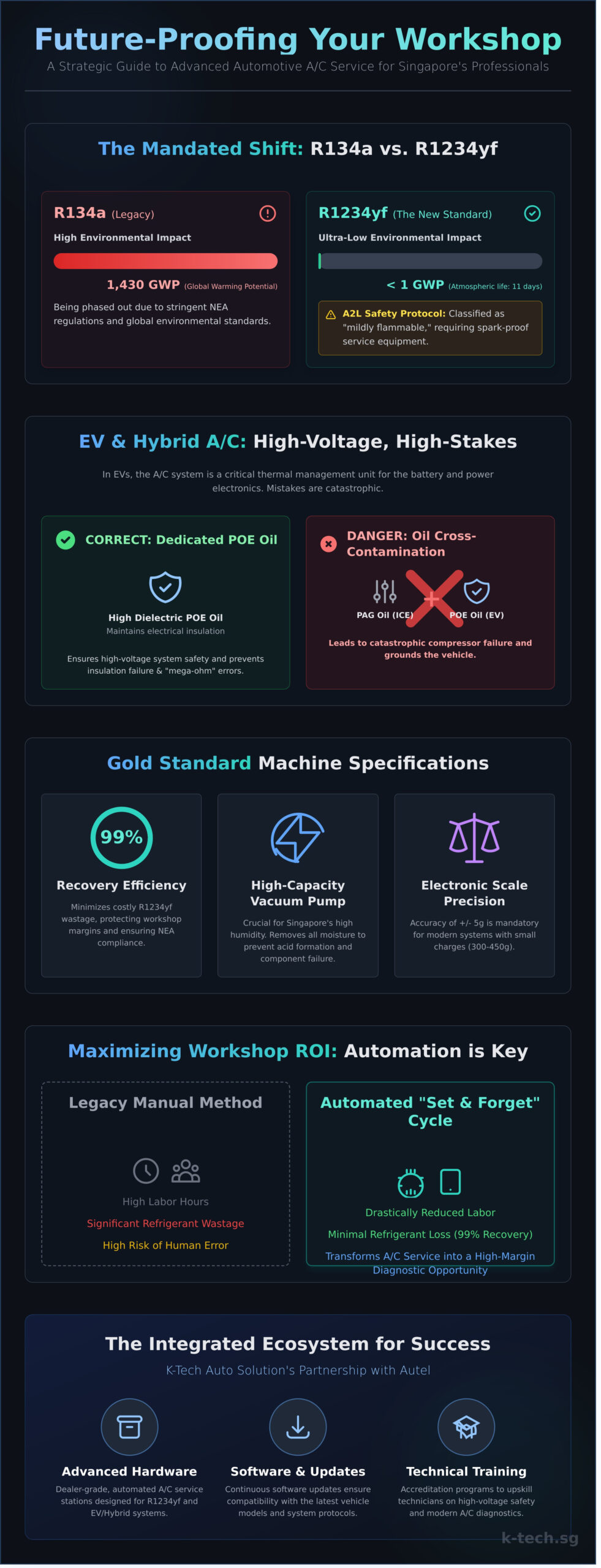
The industry shift from R134a to R1234yf is dictated by environmental necessity. R134a carries a Global Warming Potential (GWP) of 1,430, whereas R1234yf has a GWP of less than 1 and an atmospheric life of only 11 days. In Singapore, the National Environment Agency (NEA) has tightened regulations regarding the venting of fluorinated gases, making high-recovery-rate equipment mandatory for legal operation.
-
Safety Protocols: R1234yf is classified as A2L (mildly flammable), necessitating "spark-proof" internal components in any automotive air conditioning service machine used for recovery.
-
Cost Management: With R1234yf prices significantly higher than R134a, a recovery efficiency of 95% or higher is essential to protect workshop margins.
The Rise of Complex HVAC Systems in EVs
The proliferation of Electric Vehicles (EVs) has redefined the role of the HVAC system. In a modern EV, the refrigerant loop is responsible for cooling the high-voltage battery pack and power electronics, not just the cabin. This integrated thermal management requires surgical precision during the charging process.
Using outdated equipment on these architectures presents severe operational risks. Even a minor overcharge or the introduction of the wrong compressor oil (such as standard PAG oil in a system requiring high-voltage POE oil) can lead to insulation failure and "mega-ohm" errors, effectively grounding the vehicle. Professional workshops must invest in dealer-grade, automated solutions to ensure system efficiency and safety in this new era of mobility.
Essential Technical Specifications for Professional A/C Service Units
Selecting a professional automotive air conditioning service machine requires a deep dive into technical benchmarks that directly impact workshop profitability and service quality. For high-volume service centers in Singapore, equipment must meet rigorous standards to handle modern vehicle architectures and local environmental factors.
-
Recovery Efficiency: A 99% recovery rate is the established industry gold standard. High-efficiency recovery ensures that workshops minimize refrigerant loss during the extraction process, which is critical for maintaining operational margins and adhering to global environmental standards, such as those outlined in the EPA refrigerant regulations regarding HFC and HFO management.
-
Vacuum Pump Capacity: Given the high ambient humidity in the Singapore and Malaysia region, a robust vacuum pump is non-negotiable. It must be capable of reaching deep vacuum levels to boil off internal moisture that can lead to acid formation and compressor failure.
-
Electronic Scale Precision: Modern A/C systems, particularly those in European makes and EVs, often have total charge capacities as low as 300g to 450g. Precision of +/- 5g is necessary to ensure the system operates within the manufacturer’s performance envelope.
Automation and Workflow Integration
In a fast-paced workshop environment, throughput is a primary KPI. Fully automatic cycles allow technicians to initiate the recovery, vacuum, leak test, and recharge process with a single command, freeing them to perform other diagnostic tasks. Advanced units feature integrated databases that provide vehicle-specific refrigerant and oil capacities, eliminating manual lookup errors. Furthermore, thermal printers and digital reporting capabilities allow for professional documentation, providing clients with a transparent record of the weight of refrigerant recovered versus recharged.
Hardware Durability and Maintenance
For high-volume workshops, internal tank capacity should typically range between 10kg to 20kg to reduce the frequency of refilling from external cylinders. Maintenance intervals for filter-driers must be strictly monitored, as saturated filters compromise refrigerant purity and equipment longevity. The ‘Deep Vacuum’ process is defined as a 20-minute minimum standard to ensure complete moisture removal from the internal components. Investing in hardware with high-grade solenoid valves and heavy-duty casters ensures the equipment remains a reliable pillar of your workshop’s integrated automotive solution for years to advance.
Navigating Hybrid and EV Compatibility in A/C Service
As Singapore accelerates its transition toward electric mobility under the Green Plan 2030, workshops must ensure their technical capabilities align with high-voltage (HV) architecture. A standard automotive air conditioning service machine designed for internal combustion engines (ICE) is often insufficient-and potentially hazardous-when applied to Electric Vehicles (EVs) and hybrids. The primary risk lies in oil cross-contamination; while ICE systems typically use PAG oil, EV electric compressors require POE (Polyolester) oil due to its high dielectric strength. Even a trace amount of conductive PAG oil can compromise the compressor’s insulation, leading to system-wide electrical faults or safety risks for technicians.
To maintain operational safety and equipment longevity, professional workshops should prioritize units that adhere to SAE International standards. These standards ensure that the equipment features specialized flushing procedures and hardware configurations designed to prevent the mixing of lubricants. Investing in ‘Hybrid/EV Ready’ certified hardware is no longer optional; it is a critical requirement for any workshop aiming to remain a competitive partner in the evolving automotive ecosystem.
Oil Management Systems
Modern automotive air conditioning service machine units designed for electrified fleets feature independent, hermetically sealed oil injection bottles. These prevent atmospheric moisture absorption, which is vital for maintaining the dielectric properties of POE oil. Furthermore, advanced machines incorporate an automated internal circuit cleaning function. This process purges the internal hoses and manifolds of residual oil when switching between vehicle types, ensuring that the insulation resistance of the EV compressor remains within manufacturer specifications.
Diagnostic Capabilities Beyond Recharging
Thermal management in EVs is far more complex than simple cabin cooling, often involving the battery cooling circuit. Precision diagnostics are therefore essential for workshop efficiency:
-
Pressure Leak Testing: High-end units support the use of oxygen-free nitrogen or forming gas (95% nitrogen, 5% hydrogen) to identify microscopic leaks that standard vacuum tests might miss.
-
Electronic Expansion Valve (EXV) Analysis: Unlike mechanical valves, EXVs are controlled by the vehicle’s ECU. Integrated machine diagnostics can help identify software-driven flow issues versus mechanical blockages.
By adopting these specialized technologies, automotive businesses can ensure they provide the high-level technical support required for the next generation of climate control systems while maintaining the highest safety standards for their technical teams.
Maximizing Workshop ROI Through Operational Efficiency
Investing in a high-specification automotive air conditioning service machine is a strategic decision that directly impacts a workshop’s bottom line. Beyond basic functionality, the financial return on investment (ROI) is driven by precision, automation, and the reduction of consumable wastage. For Singaporean workshops, where operational costs and refrigerant prices remain high, maximizing every service cycle is essential for sustainable growth.
Managing Refrigerant Costs
The transition to R1234yf refrigerant has significantly increased the cost of consumables. High-efficiency machines mitigate these expenses by reducing gas loss from a typical 5% in older units to under 1% through superior recovery technology. Over a 12-month period, a workshop processing 300 vehicles can save substantial amounts in S$ by capturing gas that would otherwise be vented. Advanced internal management systems provide additional value by:
-
Tracking refrigerant usage per technician to ensure accountability.
-
Providing accurate data for inventory control and bulk procurement planning.
-
Automating leak detection to prevent the accidental loss of expensive gas during the charging phase.
Technician Productivity and Training
Modern equipment features fully automated "set and forget" cycles. This allows technicians to initiate a service and move on to other billable tasks-such as battery diagnostics or suspension checks-while the automotive air conditioning service machine completes the recovery, vacuum, and recharge phases. This multi-tasking capability significantly reduces labor hours per vehicle.
To fully realize these gains, workshops must bridge the gap between equipment capability and operator skill. Intuitive touch-screen interfaces reduce human error, but specialized technical training is vital for mastering advanced diagnostics. Proficiency in using these tools reduces "re-work" and warranty claims, which are often the hidden killers of workshop profitability.
Competitive Advantage through Compliance
In the Singaporean market, compliance with local environmental standards and NEA regulations is a mark of professional excellence. Utilizing equipment that produces professional report printouts allows workshops to offer transparent, data-backed A/C health checks. This level of professionalism builds trust with fleet operators and corporate clients, positioning the workshop as a sophisticated technology partner rather than a basic repair shop. For further consultation on upgrading your workshop’s capabilities, speak to our technical team at K-Tech.
Strengthening Workshop Capability with K-Tech’s Integrated Solutions
K-Tech Auto Solution serves as the exclusive technology partner for MrKool A/C service solutions in Singapore, providing a bridge between high-end hardware and workshop profitability. Selecting the right automotive air conditioning service machine is only the first step; K-Tech’s value proposition lies in a "Beyond the Box" philosophy. This ensures that every piece of equipment is backed by consistent software updates, localized technical support, and a robust supply chain for consumables, minimizing workshop downtime.
Our "Ecosystem" approach to workshop modernization focuses on four key pillars:
-
Strategic Hardware Selection: Access to dealer-grade Autel stations tailored for the Singapore climate.
-
Software Synchronisation: Regular licensing updates to cover the latest vehicle models and refrigerant specifications.
-
Local Technical Support: Direct access to K-Tech’s Singapore-based engineers for troubleshooting and maintenance.
-
Future-Readiness: Preparing workshops for the transition to R1234yf and hybrid/EV thermal management systems.
Furthermore, K-Tech provides customized workshop setup consultancy for new and expanding service centers. We analyze your specific business needs-whether you are an independent workshop or a fleet operator-to design a technical infrastructure that maximizes throughput and ROI. Our goal is to empower your business with the tools and knowledge to lead in a competitive automotive landscape.
Final Assessment: Is your workshop equipped for the next generation of climate control technology? Speak to our technical team today to evaluate your workshop’s A/C service requirements and explore our integrated technology solutions.
Conclusion: Strategic Readiness for the Future of Climate Control
To remain competitive in Singapore’s evolving automotive ecosystem, workshops must transition toward high-precision, multi-refrigerant capabilities. Selecting a high-specification automotive air conditioning service machine is a strategic investment that directly impacts workshop ROI by reducing cycle times and ensuring compatibility with the sophisticated thermal management systems found in modern Hybrid and Electric Vehicles. Beyond equipment, technical proficiency remains the cornerstone of service excellence in a landscape increasingly defined by digital diagnostics and complex system integration.
Frequently Asked Questions
What is the difference between R134a and R1234yf service machines?
The primary difference lies in the refrigerant’s chemical composition and the safety protocols required for handling. R134a has been the industry standard for years, whereas R1234yf is a low-GWP (Global Warming Potential) refrigerant found in newer vehicles. An automotive air conditioning service machine designed for R1234yf includes spark-proof components and specific couplers to prevent cross-contamination, as the two refrigerants operate at different pressures and require different recovery standards.
Can I use the same A/C machine for both internal combustion and electric vehicles?
While some dual-purpose machines exist, the critical concern is oil cross-contamination. Electric and hybrid vehicles use high-voltage compressors requiring non-conductive POE (Polyolester) oil. Using a machine that has circulated standard PAG oil can compromise the compressor’s electrical insulation, leading to system failure or safety risks. Workshops should utilize equipment with integrated internal flushing functions or dedicated machines to maintain the integrity of EV high-voltage systems.
Why is a 99% recovery rate important for my workshop’s profitability?
High recovery efficiency is a vital metric for operational profitability, especially given the rising costs of refrigerant in the Singapore market. A machine with a 99% recovery rate ensures that nearly all refrigerant is extracted and recycled, significantly reducing wastage. For high-volume service centres, these incremental savings on R1234yf and R134a procurement costs contribute directly to a faster return on investment for the equipment.
Do I need special certification to handle R1234yf refrigerant in Singapore?
Yes, technicians in Singapore must be properly trained to handle R1234yf due to its mild flammability and environmental regulations managed by the National Environment Agency (NEA). Professional competence is required to operate an automotive air conditioning service machine safely and legally. K-Tech provides specialized technical training to ensure workshop personnel meet these industry standards and can handle modern refrigerants without risk.
What maintenance is required for a professional A/C service station?
To ensure diagnostic accuracy and equipment longevity, workshops must adhere to a strict maintenance schedule. This includes replacing the vacuum pump oil every 20 to 50 hours of operation and changing the internal moisture filters regularly. Furthermore, the internal weighing scales require periodic calibration to maintain the precision necessary for modern vehicles with small refrigerant capacities, where even a 15-gram discrepancy can affect cooling performance.
How does high humidity in Malaysia and Singapore affect the A/C vacuum process?
The high ambient humidity in Singapore and Malaysia increases the amount of moisture that enters an A/C system during service. Moisture is the primary enemy of the cooling cycle, as it can form acids when mixed with refrigerant. Consequently, workshops must utilize high-performance vacuum pumps and often extend the vacuum duration to ensure all moisture is boiled off and evacuated, preventing internal corrosion and expansion valve blockages.
What are the risks of using the wrong compressor oil in a hybrid vehicle?
Using standard PAG oil in a hybrid or electric vehicle compressor is a critical error. Because PAG oil is conductive, it can cause an electrical "leak" or short circuit within the high-voltage compressor. This not only results in expensive component damage but also presents a significant safety hazard to technicians. Workshops must ensure their equipment is either dedicated to POE oil or features a verified oil-clearing protocol.
How can an automated A/C machine improve my workshop’s daily throughput?
Fully automated machines allow technicians to initiate a "set and forget" sequence covering recovery, vacuuming, leak testing, and recharging. This enables staff to perform other diagnostic tasks or mechanical repairs while the machine completes the service cycle. By reducing manual intervention and eliminating human error in fluid measurements, workshops can significantly increase their daily vehicle throughput and maintain a higher standard of service consistency.