Inefficient workflow, operational bottlenecks, and misplaced resources are significant barriers to profitability in any modern automotive workshop. These challenges often originate from a single, fundamental source: a suboptimal physical arrangement. An intelligently designed auto workshop layout is not merely an architectural consideration; it is the strategic foundation for operational excellence. It dictates the flow of every vehicle, technician, and component, directly impacting service turnaround times, technician productivity, and overall business capacity.
This comprehensive guide provides an actionable framework for designing a high-performance workshop that drives profitability. We will explore strategic space allocation for service bays, parts storage, and customer reception, while ensuring compliance with Singapore’s stringent safety standards. Furthermore, we will detail how to future-proof your investment by integrating provisions for advanced services such as EV repair and ADAS calibration, empowering your business for sustainable growth and a strong return on investment.
Key Takeaways
- Enhance operational efficiency by implementing strategic zoning that minimizes technician movement and accelerates service turnaround times.
- Optimize service bay design with precise dimensions and appropriate vehicle lift selection to maximize technician productivity and workshop versatility.
- Integrate dedicated spaces for Electric Vehicle (EV) and ADAS calibration into your auto workshop layout to secure long-term business viability.
- Identify and prevent the five most common design errors that critically impact workshop profitability and operational safety.
Foundational Principles of High-Efficiency Workshop Design
The profitability of a modern repair workshop is directly correlated to its operational efficiency. A strategic auto workshop layout is the blueprint for this efficiency, designed with one primary objective: to minimise the unnecessary movement of vehicles, technicians, and parts. Every step saved, every tool within reach, and every clear pathway contributes to reduced service turnaround times, increased job capacity, and ultimately, enhanced revenue. This foundational stage involves a comprehensive process of ‘workflow mapping’-charting the entire journey from vehicle reception to final handover. Central to this planning is the non-negotiable integration of safety and compliance standards, which protect your assets and personnel while ensuring long-term operational viability.
Optimizing Workflow: The Key to Profitability
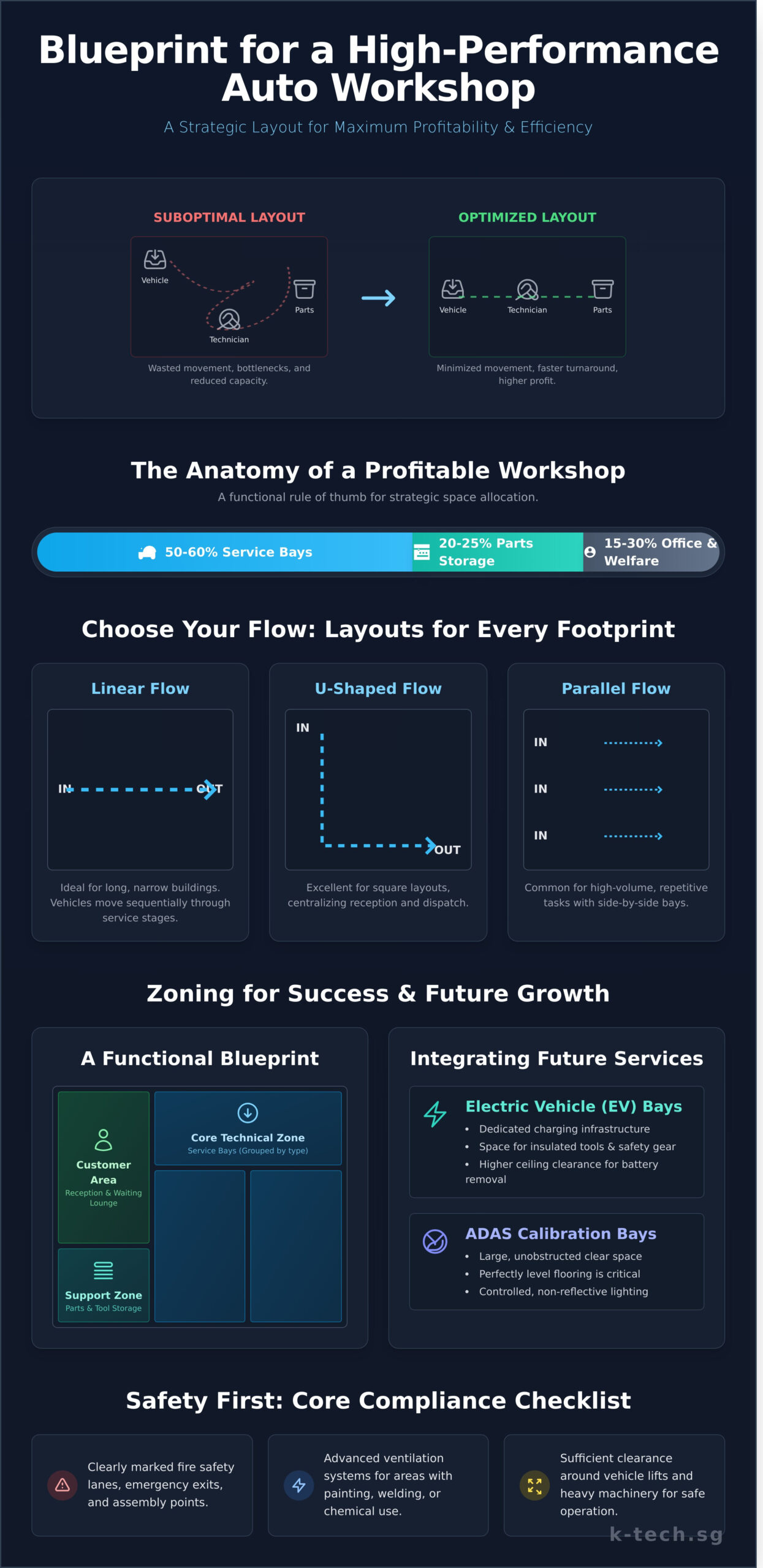
The operational heart of any professional Automobile repair shop is its workflow. Mapping the journey of a vehicle (reception -> inspection -> repair bay -> parts retrieval -> quality check -> delivery), a technician (tool station -> vehicle -> diagnostic equipment), and a part (storage -> bay) reveals critical paths and potential bottlenecks. The optimal flow pattern depends heavily on the building’s physical dimensions.
- Linear Flow: Ideal for long, narrow buildings, where vehicles enter at one end and exit at the other, moving sequentially through service stages.
- U-Shaped Flow: Excellent for square or wider layouts, allowing reception and dispatch to be located near each other, which centralises administrative and customer-facing functions.
- Parallel Flow: A common configuration where multiple service bays are arranged side-by-side, suitable for high-volume, repetitive tasks.
Space Allocation and Utilization
A well-proportioned auto workshop layout ensures every square metre serves a purpose. While exact figures vary, a functional rule of thumb is to allocate 50-60% of space to productive service bays, 20-25% to parts storage and inventory, and the remainder to office, reception, and staff welfare areas. Do not neglect vertical space; high-level racking for parts storage and wall-mounted tool systems can dramatically increase capacity. It is imperative to design clear, unobstructed pathways for both vehicle and personnel movement to prevent accidents and improve workflow.
Safety and Compliance Standards
In Singapore, adherence to Workplace Safety and Health (WSH) guidelines is not optional-it is a core component of professional workshop design. Your layout must incorporate clearly marked fire safety lanes, emergency exits, and designated assembly points. Plan for advanced ventilation systems, particularly in areas designated for painting, welding, or heavy chemical use, to manage hazardous fumes. Furthermore, ensure sufficient clearance is maintained around all vehicle lifts and heavy machinery to allow for safe operation and emergency access, protecting your technicians and your business.
Strategic Zoning: A Blueprint for a High-Functioning Workshop
An effective auto workshop layout is far more than a simple arrangement of equipment; it is a strategic blueprint that delineates specific functional zones to maximize operational efficiency. This methodical approach is fundamental to optimizing workflow, minimizing costly bottlenecks, and enhancing service throughput. By strategically allocating space, automotive workshops in Singapore can maximize their often-limited footprint and elevate the standards of service delivery, directly impacting profitability.
Customer-Facing Areas: First Impressions Matter
The client’s first physical interaction with your business must convey professionalism and competence. This zone includes a clean, well-lit reception and a comfortable waiting lounge, kept separate from the noise and activity of the technical areas. Service advisor desks should be easily accessible from the entrance, with a clear line of sight to the vehicle drop-off point to facilitate a seamless and confidence-inspiring customer check-in process.
The Core Technical Zone: Service Bays
As the revenue-generating heart of the workshop, the service bay area demands meticulous planning. Bays must be positioned for easy vehicle entry and exit, eliminating complex manoeuvres. Grouping bays by service type-such as express maintenance, advanced diagnostics, or heavy repairs-streamlines tool allocation and technician deployment. The core principles of professional workshop design stress the importance of adequate space between lifts for tool carts and safe technician movement, a critical factor for productivity.
Essential Support and Storage Zones
The efficiency of your technical team is directly supported by the strategic placement of ancillary zones. The parts department must be located for immediate access from the service bays to drastically reduce technician travel time. A secure and highly organized tool storage room, or dedicated toolboxes for each bay, prevents loss and minimizes downtime. Finally, allocating specific areas for waste disposal, air compressors, and staff facilities ensures these essential functions do not interfere with the primary operational workflow.
A high-functioning auto workshop layout integrates these zones into a cohesive system. Consider this foundational zoning checklist:
- Reception & Waiting Area: Professional, clean, and isolated from workshop noise.
- Service Bays: Grouped by task with clear, unobstructed pathways for vehicles and personnel.
- Parts Storage: Adjacent to the technical zone for rapid access.
- Tool Storage: Secure, organized, and centrally located.
- Utility & Staff Zone: Positioned away from the main customer and vehicle traffic flow.
Designing Service Bays for Maximum Productivity and Versatility
The service bay is the core revenue-generating area of any automotive workshop. Its design directly impacts technician efficiency, safety, and the range of services you can offer. An effective auto workshop layout allocates sufficient space not just for the vehicle, but for the technician and their tools to operate without restriction. For modern vehicles, including SUVs and light commercial vans prevalent in Singapore, a standard bay should be a minimum of 4 metres wide and 7 metres long, providing ample clearance around the vehicle.
Choosing and Placing Vehicle Lifts
The selection and placement of vehicle lifts are foundational decisions that dictate a bay’s function. Ceiling height is a critical constraint, with a minimum of 4 metres recommended for accommodating most two-post lifts and the vehicles they service. A strategic mix of lift types enhances operational versatility.
- Two-Post Lifts: The industry standard for general repair, offering excellent access to wheels, brakes, and undercarriage components.
- Four-Post Lifts: Ideal for vehicle inspections, wheel alignment services, and general repairs. Their drive-on design is fast and convenient for routine work. A dedicated, perfectly level bay is essential for accurate wheel alignment.
- Scissor Lifts: A space-saving solution perfect for quick services like tyre changes, brake work, and body repairs, providing a clear floor when fully retracted.
Explore our range of high-quality automotive workshop equipment to identify the advanced lifting solutions that align with your operational requirements.
Integrating Diagnostic and Repair Tools
A productive auto workshop layout positions essential equipment for seamless workflow. Centralised diagnostic stations, equipped with advanced scanners, can be shared between two bays to maximise asset utilisation. For intricate tasks like ADAS sensor calibration or ECU programming, establish dedicated, clean workstations free from the contaminants of general repair areas. Ensure pathways are at least 1 metre wide to allow mobile tool carts and diagnostic trolleys to move freely, reducing downtime between jobs.
Lighting and Utilities
Proper illumination and utility access are non-negotiable for quality work and technician safety. We recommend a dual-layer lighting strategy: general ambient lighting of at least 500 lux and focused task lighting directly above the work area delivering 1,000-1,500 lux. To maintain a safe, uncluttered floor, integrate retractable overhead reels for compressed air hoses and electrical cords. Furthermore, each bay must be equipped with sufficient power outlets and integrated data ports to support the connectivity demands of modern diagnostic systems and EV service equipment.
Sourcing the genuine automation hardware to build these robust utility and data systems is also a key consideration. For reliable components from leading industrial brands, many workshop planners turn to specialised suppliers like InstroDirect.
Future-Proofing Your Layout: Integrating EV and ADAS Services
The automotive landscape in Singapore is undergoing a fundamental transformation, driven by the widespread adoption of Electric Vehicles (EVs) and standard integration of Advanced Driver-Assistance Systems (ADAS). A forward-thinking auto workshop layout is no longer a luxury but a strategic imperative for sustainable growth. Planning for these specialized services from day one ensures your facility is equipped to capture high-margin revenue streams and meet the demands of modern vehicle owners.
Integrating these advanced capabilities requires more than just allocating space; it demands a precise understanding of the unique operational and safety protocols involved. Neglecting these considerations in your initial design can lead to costly retrofitting and operational inefficiencies.
Creating a Dedicated EV Service Bay
Servicing high-voltage electric vehicles necessitates a purpose-built environment designed around safety and efficiency. Your layout must allocate significant additional floor space around the service bay for the safe removal, handling, and storage of large battery packs. Key requirements include:
- Safety Demarcation: Clearly marked zones to restrict access to unauthorized personnel during high-voltage procedures.
- Specialized Equipment: Installation of dedicated EV charging stations and mandatory use of certified, insulated tools and personal protective equipment (PPE).
- Technical Competency: Ensuring your team is prepared is non-negotiable. Technicians must possess certified EV maintenance training to handle these advanced systems safely and effectively.
Designing an ADAS Calibration Bay
The precision required for ADAS calibration imposes strict environmental and spatial demands on your workshop. An effective auto workshop layout must incorporate a bay that meets exacting OEM standards. This includes a perfectly level floor to ensure measurement accuracy, controlled and consistent lighting to avoid sensor interference, and the complete absence of reflective surfaces. Most critically, the bay requires a large, unobstructed clear space directly in front of the vehicle to accommodate calibration targets. To learn more about meeting these stringent requirements, explore our guide on setting up a compliant ADAS calibration bay.
As Singapore’s leading provider of integrated automotive solutions, K-Tech offers the expert guidance and advanced equipment necessary to integrate these future-ready service bays into your workshop. Partner with us to build a facility engineered for profitability and industry leadership.
5 Common Auto Workshop Layout Mistakes to Avoid
An optimal auto workshop layout is fundamental to achieving peak operational efficiency. While high-quality equipment is essential, its full potential cannot be realised within a poorly designed space. Many workshops in Singapore inadvertently build inefficiencies into their floor plans, leading to lost revenue and compromised safety. Identifying and avoiding these common design errors is a critical step toward sustainable growth and profitability.
Mistake #1: Inadequate Parts Storage
Disorganised parts management is a frequent and costly issue. When components clutter service bays or are stored without a clear system, technicians waste valuable time searching for what they need. This not only delays service completion but also increases the risk of installation errors and creates significant safety hazards. A strategic solution involves implementing vertical storage systems to maximise floor space and integrating a robust inventory management system for precise tracking. The direct impact is faster service times, reduced errors, and a safer work environment.
For workshops looking to source innovative organizational products to solve these issues, curated e-commerce stores like TipTop360 can be an excellent resource.
Mistake #2: Poor Workflow and Bottlenecks
A common flaw in workshop design is the failure to map out a logical workflow. When vehicle and technician paths constantly intersect, it creates internal traffic jams and critical bottlenecks, particularly around high-traffic zones like alignment racks and diagnostic bays. To correct this, a workshop must analyse its entire service process, from vehicle reception to final quality check. Establishing clear, one-way traffic flows and logically sequencing workstations can dramatically improve throughput, allowing for more vehicles to be serviced per day.
Mistake #3: Neglecting the Customer Experience
The front-of-house experience directly influences customer perception and retention. A cramped, noisy, or unclean reception area adjacent to the workshop floor undermines the professionalism of your technical services and can deter repeat business. Best practice dictates a complete separation of the customer-facing area from the workshop’s noise, fumes, and activity. Investing in a clean, comfortable, and professional waiting lounge enhances customer satisfaction, builds trust, and justifies premium service pricing.
Ultimately, a well-conceived auto workshop layout is not an expense but a strategic investment in productivity, safety, and long-term profitability. Avoiding these fundamental mistakes requires careful planning and a deep understanding of operational dynamics. Engaging with industry specialists provides the necessary expertise to design a facility that is optimised for performance from the very beginning, forming the foundation of a successful automotive service ecosystem.
From Blueprint to Profit: Finalising Your Strategic Workshop Design
An effective workshop is built on a foundation of intelligent design. As we’ve explored, strategic zoning, optimised service bays, and proactive integration of EV and ADAS capabilities are critical components for enhancing workflow and maximising revenue. A meticulously planned auto workshop layout transcends mere organisation; it becomes a primary driver of operational efficiency and a crucial competitive advantage in Singapore’s advanced automotive sector.
Translating these principles into a high-performance reality requires specialised expertise. As a leading workshop setup consultancy, the exclusive distributor of advanced Autel equipment, and an IMI UK accredited technical training academy, K-Tech provides the end-to-end technical solutions to build your facility for sustainable growth. We empower your business with a layout engineered for peak performance and future industry demands.
Consult our experts to design your high-performance workshop layout and take the decisive step towards transforming your facility into a benchmark for productivity and profitability.
Frequently Asked Questions About Auto Workshop Layouts
How much space is required per service bay in an auto workshop?
For optimal operational efficiency, a standard service bay in a Singapore workshop should be allocated a minimum of 4 metres in width by 7 metres in depth. This dimension provides adequate clearance for modern vehicle lifts, diagnostic equipment, and tool trolleys. Allocating sufficient space is a critical component of a high-functioning workshop, ensuring technician safety and unimpeded workflow around the vehicle, which directly contributes to enhanced productivity and service quality.
What is the ideal ceiling height for a modern auto repair shop?
The ideal ceiling height for a modern auto repair facility is between 4.5 and 5.5 metres. This clearance is essential to accommodate two-post and four-post vehicle lifts at their maximum extension, which is necessary for servicing larger vehicles such as SUVs and commercial vans. An adequate vertical clearance is a non-negotiable factor for ensuring operational safety, future-proofing the workshop for evolving vehicle designs, and enabling the installation of advanced diagnostic and calibration systems.
How can I design a flexible layout that can adapt to future changes?
Designing a flexible auto workshop layout involves strategic planning for future technological integration, such as dedicated bays for electric vehicle (EV) servicing. Prioritize mobile equipment, modular tool storage systems, and overhead utility reels for air and power. This approach minimizes fixed infrastructure, allowing for rapid reconfiguration of service areas. A forward-thinking design ensures your workshop can adapt to new service demands and maintain high operational efficiency for long-term sustainable growth.
What are the most important considerations for lighting in a workshop layout?
Proper illumination is critical for precision and safety. The primary consideration is high-intensity, uniform LED lighting to eliminate shadows and reduce eye strain for technicians. A high Colour Rendering Index (CRI) of 85 or above is recommended for accurate colour matching during paint and bodywork. Additionally, integrating portable task lighting for specific diagnostic and repair procedures ensures that every component is clearly visible, thereby enhancing the quality and efficiency of the work performed.
Where is the best place to locate the air compressor to minimize noise?
To mitigate noise pollution and maintain a professional environment, the air compressor should be located away from the main work floor and customer-facing areas. The optimal solution is a dedicated, well-ventilated utility room with sound-dampening insulation. If space is limited, positioning the unit outside the main building in a secure, weatherproof enclosure is a highly effective alternative. This strategic placement is fundamental to reducing operational noise and ensuring a safer, more comfortable workshop.
How do I plan a layout for a small or unusually shaped building?
Planning an effective auto workshop layout within a constrained or non-standard space requires a focus on workflow optimization. Utilize vertical storage solutions to maximize floor area and select compact, multi-functional equipment. Create distinct zones for different tasks-such as diagnostics, general repair, and parts storage-to establish a logical process flow. A carefully considered layout ensures that even a smaller facility can achieve high levels of operational efficiency and a safe working environment.