The proliferation of Advanced Driver-Assistance Systems (ADAS) in vehicles on Singaporean roads presents both a significant opportunity and a critical challenge for modern automotive workshops. Navigating the complexities of sensor calibration and system diagnostics without formal, specialized knowledge introduces substantial operational risk and liability concerns. For many workshop owners, the path to developing these new technical capabilities is unclear, making the investment in equipment and professional adas technician training seem daunting and difficult to justify.
This comprehensive guide is engineered to address these challenges directly, providing automotive professionals with essential, actionable information. We will deliver a clear framework for understanding the core competencies required of a modern ADAS technician, from advanced diagnostics to precision calibration procedures. Furthermore, we will outline the crucial criteria for selecting a high-quality, accredited training program in Singapore, empowering you to make a strategic investment that mitigates risk, builds a profitable ADAS service department, and future-proofs your workshop for sustainable growth.
Key Takeaways
- The industry shift from mechanical to electronic systems makes specialized ADAS servicing a non-negotiable capability for modern automotive workshops.
- Learn to identify the core competencies of a qualified ADAS technician and use our checklist to evaluate and select a high-quality training provider.
- Understand how investing in professional adas technician training delivers a significant return by increasing service revenue and enhancing workshop efficiency.
- Recognize the critical importance of internationally recognized accreditations, such as from the Institute of the Motor Industry (IMI), in validating a program’s credibility.
Why Specialized ADAS Training is Non-Negotiable for Modern Workshops
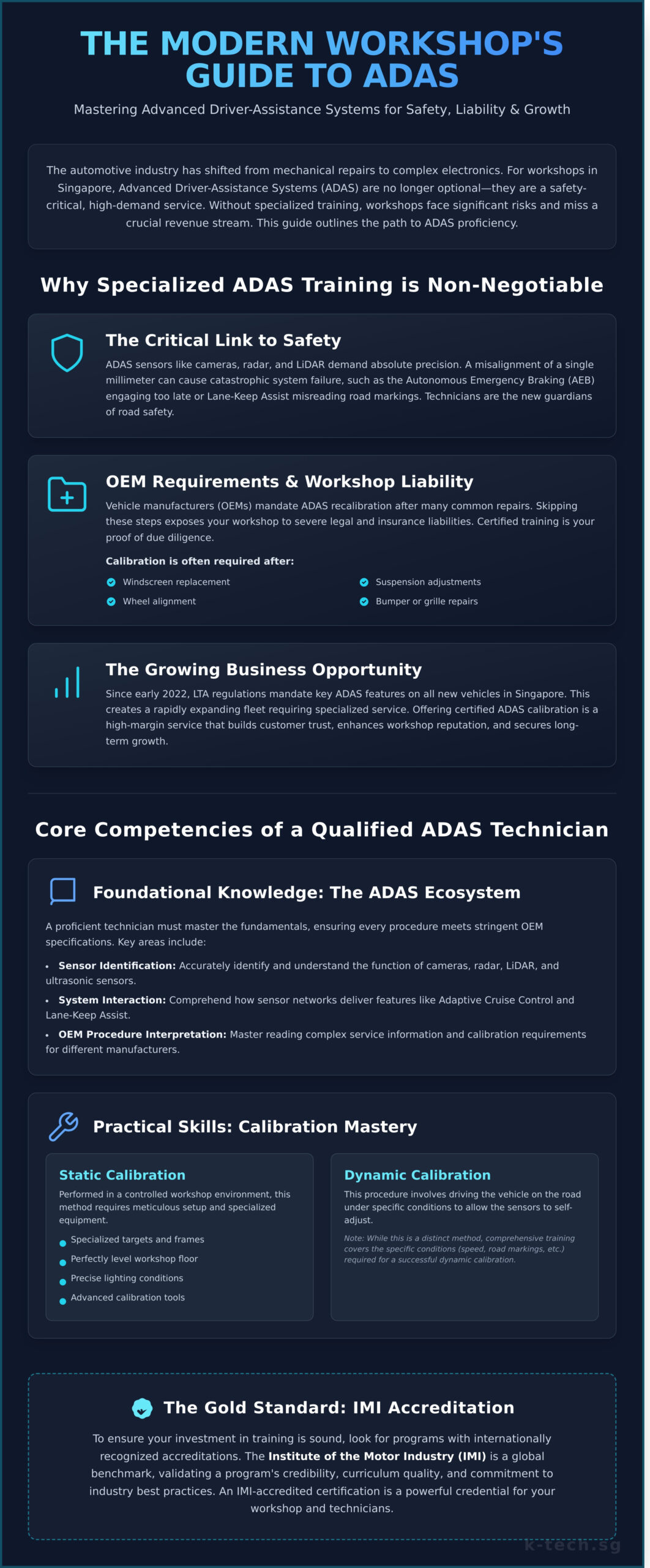
In today’s automotive landscape, the shift from purely mechanical repairs to complex electronics servicing is accelerating. The proliferation of Advanced Driver-Assistance Systems (ADAS) has fundamentally altered vehicle maintenance, transforming these features from optional luxuries into standard, safety-critical components. For modern workshops in Singapore, possessing the technical capabilities to service these systems is no longer a competitive advantage-it is an operational necessity. Without professional adas technician training, workshops risk compromising vehicle safety, incurring significant legal liabilities, and missing out on a substantial revenue stream.
The Critical Link Between Safety and Precision Calibration
ADAS functions rely on a network of sensors-cameras, radar, and lidar-that must be calibrated with absolute precision. A misalignment of even a single millimetre can lead to system failure. For instance, an improperly calibrated forward-facing camera could cause the Lane-Keep Assist to misread road markings or the Autonomous Emergency Braking (AEB) system to engage too late or not at all. The technician’s role has evolved to that of a safety guardian, where precise calibration is directly responsible for the driver’s, passengers’, and other road users’ well-being.
OEM Requirements and Workshop Liability
Vehicle manufacturers (OEMs) have established stringent procedures that mandate ADAS recalibration after many common repairs. These include routine services such as:
- Windscreen replacement
- Suspension adjustments
- Wheel alignment
- Bumper or grille repairs
Skipping these mandatory steps exposes a workshop to severe legal and insurance liabilities in the event of a system-related accident. Documented, certified adas technician training serves as crucial evidence of due diligence, protecting your business by demonstrating a commitment to OEM standards and industry best practices.
The Growing Business Opportunity in ADAS Services
The demand for ADAS calibration in Singapore is expanding rapidly. Since early 2022, LTA regulations have mandated key ADAS features on all new passenger and light commercial vehicles, creating an ever-growing fleet that requires specialized servicing. Offering certified ADAS calibration is not just a repair task; it is a high-margin, essential service that forward-thinking workshops can leverage for sustainable growth. Providing this expert service builds immense customer trust, enhances workshop reputation, and secures long-term client retention in a competitive market.
Core Competencies: What Every ADAS Technician Must Know
A truly competent ADAS technician possesses a sophisticated blend of deep theoretical knowledge and precise practical skills. This combination is non-negotiable for ensuring vehicle safety and operational integrity following any service. The benchmark for excellence in this field is defined by a meticulous, process-driven approach where absolute adherence to Original Equipment Manufacturer (OEM) procedures is paramount. Comprehensive adas technician training is the only path to achieving this level of proficiency, moving beyond basic repairs to mastering complex system integrations.
Foundational Knowledge: Understanding ADAS Systems
A proficient technician must first master the fundamentals of the complex ADAS ecosystem. This foundational knowledge includes the ability to accurately identify and understand the function of various ADAS sensors-from forward-facing cameras and radar units to LiDAR and ultrasonic sensors. It is crucial to comprehend how these components interact to deliver features like adaptive cruise control or lane-keeping assist. A core skill is interpreting complex OEM service information and calibration requirements, a standard heavily emphasized in professional programs like I-CAR ADAS training, to ensure every procedure meets stringent manufacturer specifications.
Practical Skills: Static and Dynamic Calibration
Theoretical knowledge must be paired with hands-on expertise in both primary calibration methods. Each requires a distinct skill set, environment, and set of advanced tools to execute correctly.
- Static Calibration: This procedure is performed in a controlled workshop environment. It requires using specialized targets and frames positioned at precise distances and heights relative to the vehicle, demanding a perfectly level floor, specific lighting conditions, and advanced calibration equipment.
- Dynamic Calibration: This method involves driving the vehicle under specific, OEM-stipulated conditions-such as a steady speed on a road with clear lane markings-to allow the ADAS sensors to self-calibrate. Technicians must execute the exact road test procedure to ensure a successful outcome.
Diagnostic Expertise and Documentation
Advanced diagnostic capability is the final pillar of ADAS competence. This involves more than simply clearing codes; it requires the proficient use of diagnostic scan tools to perform comprehensive pre-scan and post-scan health checks on the vehicle’s electronic systems. Technicians must be able to interpret ADAS-specific fault codes accurately to pinpoint system malfunctions. Critically, every calibration must conclude with a detailed post-calibration report. This documentation is essential for workshop liability, quality assurance, and providing clients with verifiable proof of a correctly and safely performed service.
How to Evaluate ADAS Training Programs: A Checklist for Success
Selecting a provider for your team’s adas technician training is a critical investment in your workshop’s future operational readiness and profitability. The quality of instruction directly impacts your team’s ability to perform precise, safe, and efficient calibrations. To ensure a high return on this investment, workshop owners must look beyond the initial cost and evaluate programs based on tangible markers of quality. This checklist provides a clear framework for making an informed, strategic decision.
Accreditation and Certification
Globally recognized accreditation is the primary indicator of a high-quality training program. Look for providers accredited by esteemed bodies like the Institute of the Motor Industry (IMI) from the UK. Accreditation signifies that the curriculum, instructors, and facilities have been rigorously vetted and meet stringent international standards. This ensures the certificate your technicians receive is not just a piece of paper, but a respected credential that validates their advanced technical capabilities within the industry.
Curriculum and Training Methodology
A comprehensive curriculum is foundational to developing competent technicians. The program must provide a balanced blend of in-depth classroom theory and extensive hands-on practice. Before committing, verify that the syllabus covers all core ADAS competencies, from sensor identification and diagnostic principles to static and dynamic calibration procedures. Inquire about class sizes; smaller groups often facilitate more personalised instruction and allow for greater interaction with the trainer and equipment, accelerating the learning process.
Training Equipment and Instructor Expertise
Effective training is impossible without access to current, industry-standard equipment. A premier training facility should utilize advanced calibration tools, such as Autel ADAS calibration frames and diagnostic scanners, that your technicians will encounter in a modern workshop environment. Equally important is the instructor’s background. The most effective trainers are seasoned practitioners with extensive real-world experience in ADAS diagnostics and repair. Their ability to share practical insights and troubleshoot complex scenarios is invaluable and far exceeds what can be learned from theory alone.
The K-Tech Advantage: IMI-Accredited ADAS Training in Singapore
Selecting the right training partner is a critical investment in your workshop’s future. K-Tech Auto Solution’s Training Academy provides a definitive, industry-leading programme designed to elevate your team’s technical capabilities and ensure your business remains at the forefront of automotive technology. Our comprehensive approach directly addresses the essential criteria for high-quality training, delivering an integrated solution that combines globally recognised certification with practical, hands-on expertise.
As Singapore’s premier provider of advanced automotive solutions, we have meticulously developed an adas technician training programme that sets the industry standard for excellence and operational readiness.
IMI UK Certified Training for Industry Recognition
The Institute of the Motor Industry (IMI) is the leading professional body for the global automotive sector, setting and upholding standards for technical competence. An IMI-accredited certificate is more than a qualification; it is a globally recognised benchmark of quality. For technicians, it validates their skills to an international standard, while for workshops, it provides undeniable proof of professionalism and commitment to excellence, building significant trust with customers and insurance partners.
Hands-On Training with Advanced Autel Equipment
Theoretical knowledge must be paired with practical application. At K-Tech, we ensure trainees gain extensive hands-on experience using the same advanced equipment they will operate professionally. Our facility is equipped with state-of-the-art Autel ADAS calibration systems, including the IA900WA Wheel Alignment and ADAS Calibration Frame. This approach ensures technicians are not just familiar with concepts but are fully competent and confident in performing precise calibrations on a wide range of vehicles from day one.
A Comprehensive Curriculum for Real-World Competence
Our curriculum is structured to build a deep, functional understanding of ADAS, moving from foundational principles to complex diagnostic challenges. Key modules in our adas technician training include:
- Fundamentals of ADAS sensors, including cameras, radar, and LiDAR.
- Procedures for both static and dynamic calibration.
- Advanced diagnostic strategies for identifying and rectifying ADAS faults.
- System integration and understanding OEM requirements.
- Health and safety protocols for working with advanced vehicle systems.
This robust curriculum ensures your technicians can confidently and accurately service the most sophisticated vehicles on the road. View our ADAS training course schedule and enrol today.
Building the Business Case: The ROI of Investing in ADAS Training
For many workshop owners, the primary objection to advanced training is the initial cost. However, viewing professional adas technician training not as an expense, but as a strategic investment, is crucial for long-term viability. The return on this investment is multifaceted, delivering new revenue, enhanced operational efficiency, and a significant competitive advantage in Singapore’s sophisticated automotive market.
Developing New, High-Margin Revenue Streams
Properly trained technicians unlock the ability to offer essential, high-margin ADAS calibration services. In Singapore, these services represent a significant revenue opportunity. By performing these in-house, you capture profits that would otherwise be lost to third-party specialists.
- Sample Service Pricing: A single front-camera calibration following a windscreen replacement can be billed at S$250 – S$400. A more comprehensive calibration for multiple sensors after collision repair can command S$500 or more.
- Rapid ROI: With these margins, the initial investment in training and equipment can often be recouped after completing just a handful of calibration jobs.
- Strategic Bundling: Integrate ADAS calibration as a standard, value-added service with windscreen replacements, bumper repairs, and suspension work to increase the average invoice value.
Increasing Labour Rates and Workshop Efficiency
Certified ADAS expertise justifies a higher labour rate, reflecting the advanced skill set and technical precision required. This specialisation directly enhances profitability. Furthermore, trained technicians operate with greater speed and accuracy, reducing diagnostic time and eliminating the costly errors and comebacks associated with improper calibration. This focus on first-time-right repairs improves workshop throughput and customer satisfaction.
Becoming a Market Leader and Trusted Partner
Marketing your workshop as an IMI-certified ADAS service centre differentiates your business from the competition. This credential builds immediate trust with customers and, critically, with insurance companies who prioritise safe, OEM-compliant repairs. It also positions your workshop to become a vital B2B partner, providing specialised calibration services to other collision centres, windscreen specialists, and mechanical workshops that lack in-house capabilities.
Ultimately, the question is not whether you can afford to invest in adas technician training, but whether you can afford not to. As ADAS technology becomes standard on nearly every new vehicle, possessing this capability is non-negotiable for future survival and growth. Equipping your team with these skills is the definitive step towards securing a profitable, sustainable future as a leader in the automotive service industry. Discover how K-Tech’s advanced training solutions can elevate your business.
Secure Your Workshop’s Future with Strategic ADAS Competency
The proliferation of Advanced Driver-Assistance Systems represents a fundamental shift in the automotive industry, making specialized training non-negotiable for modern workshops. Investing in a high-calibre adas technician training program is a strategic decision that directly enhances your workshop’s profitability, operational efficiency, and long-term viability in the competitive Singapore market. Choosing the right accredited partner is paramount to achieving a significant return on this crucial investment.
At K-Tech, we provide a distinct competitive advantage. As an IMI UK Accredited Technical Training Academy and the exclusive Singapore distributor for Autel, we offer unparalleled, hands-on instruction using the industry-leading diagnostic and ADAS equipment your technicians will encounter daily. Our commitment to excellence ensures your team develops the advanced capabilities required to service the next generation of vehicles with confidence and precision.
Take the decisive step to elevate your service standards. Enrol in our IMI-accredited ADAS Training Academy to future-proof your workshop. Position your team at the forefront of automotive technology today.
Frequently Asked Questions About ADAS Technician Training
What are the prerequisites for enrolling in an ADAS training course?
Participants should possess a foundational understanding of automotive systems, including vehicle electronics and diagnostics. While formal prerequisites may vary, a background as a qualified automotive technician, holding credentials such as a Nitec or Diploma in Automotive Technology, is strongly recommended. This prior experience ensures a solid base for grasping the advanced concepts of sensor technology, network communication, and calibration procedures covered in our comprehensive adas technician training programs.
How long does a typical ADAS technician training program take?
The duration of an ADAS training program depends on the course’s depth and specialization. Foundational courses typically range from two to five days, providing a comprehensive overview of ADAS principles and basic calibration techniques. More advanced, IMI-accredited certification programs may require a longer commitment to cover complex diagnostics and multi-system integration. Our training methodology emphasizes both theoretical knowledge and extensive hands-on practice with advanced workshop equipment to ensure operational proficiency.
Is online-only ADAS training effective?
While online modules can effectively deliver theoretical knowledge on ADAS principles, they are insufficient as a standalone training solution. Effective ADAS competency is built upon practical, hands-on application. Performing precise static and dynamic calibrations requires proficiency with specialized physical equipment, targets, and diagnostic tools. We advocate for a blended learning approach that combines foundational theory with intensive, in-person workshop sessions to develop true technical capability and ensure adherence to manufacturer specifications.
How often do ADAS technicians need refresher training?
Given the rapid evolution of ADAS technology and the continuous introduction of new vehicle models and sensor systems, ongoing professional development is critical. We recommend that certified technicians undertake refresher training or advanced modules every 18 to 24 months. This ensures they remain current with the latest OEM calibration procedures, diagnostic software updates, and emerging technologies. Continuous learning is a key component of maintaining technical excellence and delivering safe, accurate vehicle servicing.
What is the career path for a certified ADAS technician?
A certified ADAS technician is positioned for significant career advancement within the automotive industry. An initial role focuses on performing precise calibrations and diagnostics. With experience, a technician can progress to a senior ADAS Specialist, a Workshop Manager overseeing the calibration division, or a Technical Trainer. This specialized skill set is in high demand across Singapore, leading to enhanced career stability, increased earning potential, and opportunities in advanced diagnostics and workshop management roles.
Can I use my existing diagnostic scanner for ADAS calibration?
While many modern diagnostic scanners possess some ADAS-related functions, their capability for professional calibration is often limited. A comprehensive ADAS calibration requires an integrated system that includes vehicle-specific software, up-to-date licenses, and the correct physical targets and frames. Using a standard diagnostic tool without this complete ecosystem can lead to inaccurate calibrations, compromising vehicle safety and operational integrity. We recommend investing in a dedicated, professional-grade ADAS calibration system.