For many professional workshops in Singapore, standard OBD2 diagnostics have long been an indispensable tool. However, as vehicle technology advances, technicians are increasingly encountering challenges that extend beyond the capabilities of these fundamental devices. This often leads to significant time loss, unresolved complex faults, and a clear ceiling on workshop efficiency when dealing with systems outside of the engine and emissions controls.
Understanding the precise capabilities and inherent limitations of this universal protocol is critical for maintaining a competitive edge. This professional guide provides a comprehensive analysis of what a standard OBD2 system can achieve and, more importantly, where it falls short. We will explore the critical differences between generic scanners and advanced, OEM-level diagnostic systems, offering the clarity needed to make informed decisions about your workshop’s technical capabilities.
By delineating these boundaries, we aim to equip automotive professionals with the knowledge to not only diagnose a wider range of vehicle faults with greater accuracy but also to strategically justify the investment in advanced diagnostic solutions. This understanding is fundamental to enhancing operational efficiency and solidifying your workshop’s reputation for high-quality, comprehensive service.
Key Takeaways
- Recognise that the OBD2 standard is a government-mandated protocol designed specifically for monitoring powertrain and emissions-related systems.
- Identify the critical limitations of standard obd2 diagnostics, which cannot access the majority of a modern vehicle’s non-engine electronic modules.
- Differentiate between generic scanners and OEM-level systems to understand when a diagnostic escalation is required for accurate, in-depth fault finding.
- Develop an effective workshop strategy that uses OBD2 for rapid initial assessments and advanced tools for comprehensive repairs and system calibrations.
Foundations of OBD2: The Standard for Emissions Diagnostics
On-Board Diagnostics, generation two (OBD2), represents a critical evolution in vehicle maintenance and emissions control. Mandated for all vehicles sold in the United States from 1996 onwards, and subsequently adopted as a global standard, OBD2 provides a universal framework for monitoring a vehicle’s core powertrain and emissions systems. This system was developed to supersede the less-standardised OBD1 protocols, creating a cohesive platform for technicians. The primary function of OBD2 is to detect and report faults that could increase a vehicle’s pollutant output, thereby ensuring compliance with environmental regulations. As detailed in comprehensive resources on On-board diagnostics (OBD), this standardisation provides every professional workshop with a fundamental baseline for initial fault assessment.
The OBD2 Data Link Connector (DLC)
At the heart of the OBD2 system is the Data Link Connector (DLC), a standardised 16-pin J1962 female connector. Its design and pinout are universal, ensuring any compliant scan tool can interface with any modern vehicle. By regulation, the DLC must be located within the vehicle’s cockpit, typically under the dashboard on the driver’s side. This port serves as the gateway to the vehicle’s computer network, supporting various communication protocols such as CAN (Controller Area Network), K-Line, and J1850 to transmit diagnostic data.
Understanding Diagnostic Trouble Codes (DTCs)
When a vehicle’s onboard computer detects a fault, it generates a Diagnostic Trouble Code (DTC) and often illuminates the Malfunction Indicator Lamp (MIL). Each DTC follows a standardised five-character alphanumeric structure, such as the common P0420 (Catalyst System Efficiency Below Threshold). The first character is crucial for identifying the system area:
- P: Powertrain (Engine, Transmission)
- B: Body (Airbags, Power Seating, Lighting)
- C: Chassis (ABS, Steering, Suspension)
- U: Network & Vehicle Integration (Module Communication)
Furthermore, the second character indicates if the code is generic (P0xxx) or manufacturer-specific (P1xxx), a key distinction in advanced diagnostics.
Live Data Stream (Parameter IDs – PIDs)
Beyond static trouble codes, professional obd2 diagnostics involve analysing the live data stream, also known as Parameter IDs (PIDs). PIDs are real-time operational data reported by the vehicle’s sensors and actuators. This data includes critical values such as engine RPM, vehicle speed, coolant temperature, oxygen sensor voltage, and fuel trim. Monitoring these parameters allows a skilled technician to observe system performance under various conditions, providing essential context for diagnosing intermittent or complex faults before component replacement is considered.
Core Capabilities: What a Generic OBD2 Scanner Can Do for a Workshop
For any professional automotive workshop, a generic OBD2 scanner represents the foundational layer of the diagnostic process. While not as comprehensive as OEM-level systems, its capabilities are indispensable for initial vehicle assessments, basic troubleshooting, and enhancing operational efficiency. These tools provide a universal language for communicating with a vehicle’s primary powertrain control module (PCM), offering a crucial first look into system performance.
Effective use of these fundamental features allows technicians to quickly triage issues, verify the success of repairs, and provide clients with clear, data-backed initial findings. The core functions of standard obd2 diagnostics are universally applicable to all modern vehicles and form the bedrock of any competent repair strategy.
Reading and Clearing Powertrain DTCs
The most fundamental function of any OBD2 scanner is retrieving and clearing Diagnostic Trouble Codes (DTCs) from the powertrain. When a Malfunction Indicator Lamp (MIL), or Check Engine Light, is illuminated, the scanner interfaces with the vehicle to read the specific “P” codes (powertrain) that have been stored. It is standard professional practice to record all codes and associated data before clearing them, as this information is vital for an accurate diagnosis. Once a repair is successfully completed, the scanner is used to clear the codes and extinguish the MIL, serving as the final step in the service.
Viewing Live Data and Freeze Frame Data
Beyond simple code reading, OBD2 scanners provide access to two critical data streams:
- Live Data: This function displays real-time information from various powertrain sensors, such as engine RPM, coolant temperature, oxygen sensor voltage, and fuel trims. Technicians can use this to observe system behaviour under specific operating conditions, helping to identify intermittent faults or failing components.
- Freeze Frame Data: This provides a snapshot of the vehicle’s operating conditions at the exact moment a DTC was triggered. This data includes parameters like vehicle speed, engine load, and temperature, offering invaluable context to understand the circumstances that caused the fault. For example, diagnosing a misfire code is far more effective when you can see the fuel trim and O2 sensor readings at the moment it occurred.
Checking I/M Readiness Status
Inspection/Maintenance (I/M) Readiness status is a critical function for verifying that a vehicle’s emissions-related systems are functioning correctly. The vehicle’s computer runs a series of self-tests, or monitors, on components like the catalytic converter and EVAP system. An OBD2 scanner can display the status of these monitors (“Ready” or “Not Ready”). In Singapore, this is particularly important for pre-inspection checks to ensure a vehicle will pass its mandatory Land Transport Authority (LTA) inspection, preventing costly and time-consuming re-inspections for the customer.
Critical Limitations: Why OBD2 is Not Enough for a Professional Workshop
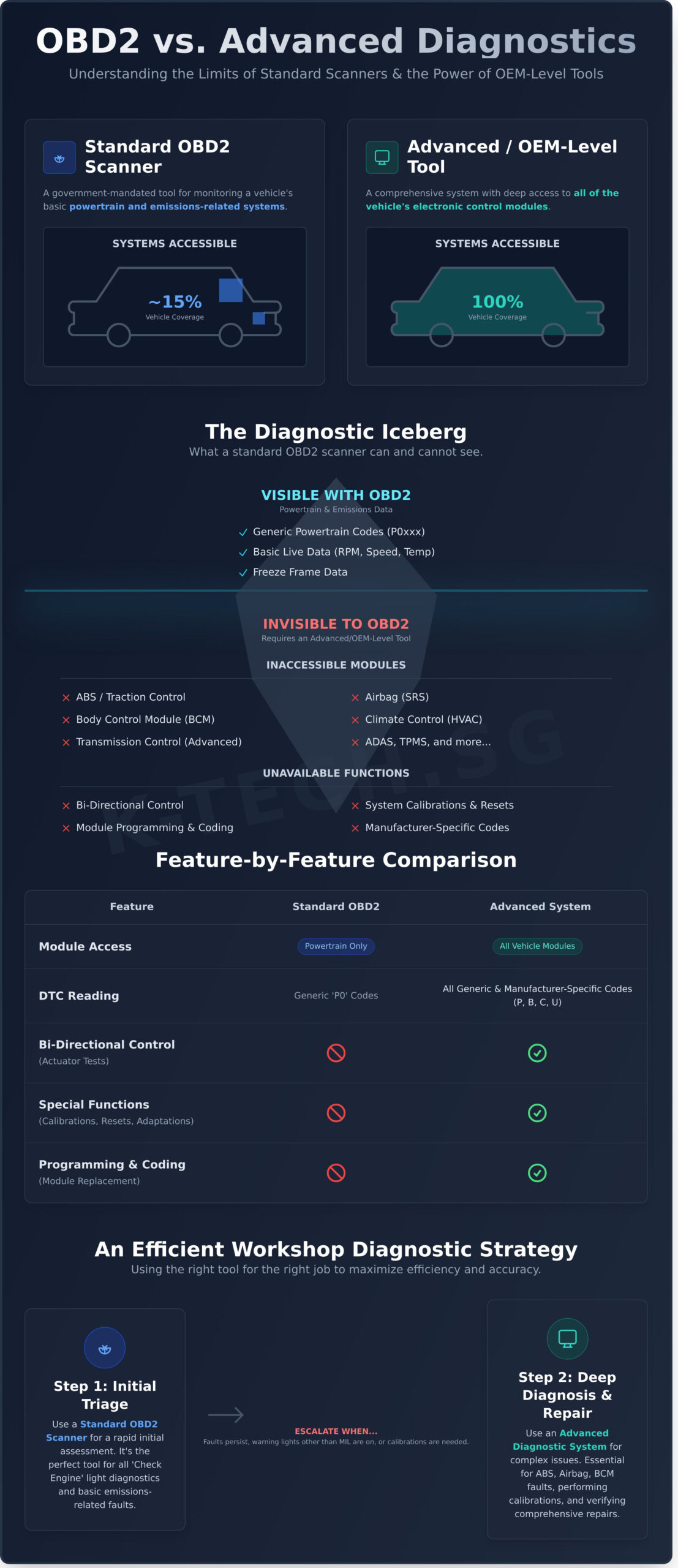
While the On-Board Diagnostics (OBD2) standard provides a crucial baseline for engine and emissions-related issues, its scope is intentionally narrow. For a professional workshop in Singapore, relying solely on generic OBD2 scanners creates significant diagnostic dead-ends and severely restricts service capabilities. The intricate electronic ecosystems of modern vehicles extend far beyond the powertrain, and accessing these systems is fundamental to providing comprehensive, accurate, and efficient service.
The limitations of standard obd2 diagnostics directly impact a workshop’s operational efficiency and profitability by creating information gaps that only OEM-level tools can fill.
No Access to Other Control Modules
A modern vehicle contains dozens of interconnected electronic control modules, yet generic OBD2 tools can only communicate with the Engine Control Module (ECM) and Transmission Control Module (TCM). This leaves technicians blind to a vast array of other critical systems. Warning lights related to the following modules cannot be diagnosed or reset:
- Anti-lock Braking System (ABS)
- Supplemental Restraint System (SRS/Airbag)
- Body Control Module (BCM)
- Tire Pressure Monitoring System (TPMS)
- Climate Control and Infotainment Systems
For instance, if a vehicle presents with an illuminated ABS light, a standard OBD2 scanner will find no fault codes, as it cannot interface with the brake control module.
Lack of Bidirectional Control
Effective diagnostics requires more than just reading data; it demands active testing. Bidirectional control is the ability for a scan tool to send commands directly to a vehicle’s modules and components, a function entirely absent in OBD2. This capability is essential for pinpointing faults efficiently. Without it, technicians cannot perform vital tests such as activating a fuel pump to check pressure, cycling ABS solenoids to test functionality, or commanding an EVAP system purge valve to verify its operation.
Inability to Perform Special Functions
Beyond diagnostics, professional workshops routinely perform service and maintenance procedures that require advanced tool functions. Standard OBD2 offers no support for these critical tasks. Common procedures like resetting service and oil lights, retracting an Electronic Parking Brake (EPB) for pad replacement, or performing a steering angle sensor (SAS) calibration are impossible. Furthermore, advanced functions like new component adaptations, ECU coding, and key programming are exclusive to OEM-level diagnostic systems, making them indispensable for many common repairs.
To deliver complete and professional service, workshops must be equipped with tools that overcome these fundamental limitations. Don’t let tool limitations slow you down. Explore advanced diagnostic solutions.
Beyond OBD2: The Power of OEM-Level Diagnostic Systems
While standard OBD2 scanners provide a baseline for engine-related issues, professional automotive workshops require a far more advanced solution to remain competitive and efficient. OEM-level diagnostic systems are engineered to address the limitations of basic tools, replicating the proprietary software used by vehicle manufacturers. These powerful platforms, from globally recognized brands like Autel, consolidate dealership-level capabilities for numerous vehicle makes into a single, high-performance device.
Comprehensive All-System Access
Unlike readers limited to the powertrain, professional scanners grant complete access to every electronic control module in a vehicle. This includes the Anti-lock Braking System (ABS), Supplemental Restraint System (SRS), Body Control Module (BCM), and dozens of others. Technicians can view comprehensive live data streams and accurately diagnose complex network communication faults across the CAN bus, a task impossible with standard obd2 diagnostics.
Advanced Functions and Bidirectional Controls
The true power of these systems lies in their bidirectional controls and special functions. These are not just for reading data; they allow technicians to send commands to the vehicle to perform active tests and crucial service procedures, saving hours of manual inspection. Key functions include:
- Injector Coding: Ensuring new injectors perform to precise manufacturer specifications.
- Steering Angle Sensor (SAS) Calibration: A mandatory step after wheel alignment or suspension work.
- Battery Registration: Informing the vehicle of a new battery’s specifications to ensure proper charging and longevity.
These advanced procedures are essential for completing modern vehicle repairs correctly and safely.
Topology Mapping and Guided Diagnostics
Advanced diagnostic tools introduce features like topology mapping, which provides a visual, colour-coded diagram of the vehicle’s entire module network. This allows a technician to see the communication status of all ECUs at a glance, instantly identifying which modules are offline or reporting errors. This visual approach transforms complex network diagnosis from hours of guesswork into minutes of targeted analysis.
Preparing for the Future: ADAS and EV Diagnostics
The automotive landscape in Singapore is rapidly evolving with the rise of Electric Vehicles (EVs) and Advanced Driver-Assistance Systems (ADAS). Services such as ADAS camera calibration, radar alignment, and in-depth EV battery pack analysis are becoming standard workshop requirements. These high-level tasks are far beyond the scope of any generic OBD2 tool. Investing in an OEM-level system is an essential strategy for any workshop looking to provide comprehensive obd2 diagnostics and future-proof its service offerings. Explore the advanced solutions that keep your business ahead at k-tech.sg.
Developing Your Workshop’s Diagnostic Strategy
A forward-thinking diagnostic strategy acknowledges the distinct roles of different tool tiers. While basic obd2 diagnostics are indispensable for quick, preliminary checks and verifying Malfunction Indicator Lamps (MILs), they represent only the starting point. For the complex, in-depth repairs required by today’s vehicles, an OEM-level diagnostic system is a fundamental necessity. Viewing this advanced equipment not merely as an expense, but as a strategic investment in your workshop’s technical capability, operational efficiency, and future profitability is critical for sustainable growth in Singapore’s competitive automotive market.
Investing in a professional, OEM-level diagnostic tool directly translates to an expanded scope of service and increased revenue streams. The capability to perform high-value, specialised tasks-such as ECU coding, component adaptation, service interval resets, and ADAS calibrations-positions your workshop as a high-end service provider. This advanced functionality not only attracts more complex and profitable jobs but also builds a strong reputation for expertise. Ultimately, delivering accurate, first-time fixes significantly improves customer satisfaction, fostering long-term loyalty and generating powerful word-of-mouth referrals.
Calculating the ROI of an Advanced Scanner
The return on investment for an advanced scanner is tangible and multifaceted. A proper calculation must account for both direct revenue and avoided costs:
- Enhanced Efficiency: Drastically reduce diagnostic time per vehicle, allowing technicians to complete more jobs per day and increasing overall workshop throughput.
- New Revenue Streams: Unlock profitable, high-demand services like key programming and module initialisation, which can command fees of several hundred Singapore Dollars per task.
- Reduced Opportunity Cost: Eliminate the need to turn away complex diagnostic jobs, preventing the loss of both immediate revenue (often S$500+ per job) and valuable long-term customer relationships.
The Importance of Training and Support
A powerful diagnostic tool is only as effective as the technician operating it. To unlock the full potential of your equipment and ensure safe, accurate repairs, continuous professional development is essential. Proper training empowers your team to interpret complex live data, navigate advanced functions, and understand system interdependencies. Furthermore, reliable technical support and regular software updates are vital for keeping your capabilities current with the latest vehicle technology. Maximize your investment with IMI-accredited technical training from K-Tech.
Elevating Your Diagnostic Strategy Beyond OBD2
In the modern automotive workshop, mastering diagnostics is non-negotiable. While the OBD2 standard provides a foundational layer for emissions-related issues, its inherent limitations become clear when servicing the complex systems of today’s vehicles. A truly effective approach acknowledges that while essential, generic obd2 diagnostics is merely the first step. The key to unlocking superior accuracy and operational efficiency lies in integrating advanced, OEM-level capabilities into your workflow.
To bridge this capability gap, a strategic investment in professional-grade equipment is paramount. As the exclusive Singapore distributor for Autel, K-Tech Auto Solution provides industry-leading diagnostic systems designed to empower your technicians. Our commitment extends beyond equipment; we deliver comprehensive support and IMI UK accredited technical training to ensure your team maximises its potential. Equip your workshop with industry-leading Autel diagnostic systems. Contact K-Tech today.
By adopting an advanced diagnostic strategy, your workshop can confidently tackle any challenge, enhance its reputation for excellence, and secure its position as a leader in Singapore’s competitive automotive service industry.
Frequently Asked Questions About OBD2 Diagnostics
Can a standard OBD2 scanner diagnose ABS, airbag, or TPMS lights?
A standard OBD2 scanner is typically limited to diagnosing issues within the powertrain control module (PCM), primarily related to engine and emissions systems. Consequently, it cannot access or interpret fault codes from other critical systems like the Anti-lock Braking System (ABS), Supplemental Restraint System (SRS/airbag), or Tyre Pressure Monitoring System (TPMS). To accurately diagnose these specific systems, workshops require advanced, OEM-level diagnostic tools that provide comprehensive, all-system communication capabilities for effective and precise servicing.
What is the difference between a generic DTC and a manufacturer-specific DTC?
Generic Diagnostic Trouble Codes (DTCs), typically starting with ‘P0’, are standardized codes mandated by the OBD2 protocol and identify common powertrain faults across all vehicle makes. In contrast, manufacturer-specific DTCs (e.g., starting with ‘P1’, ‘B1’, ‘C1’, ‘U1’) are proprietary codes created by the Original Equipment Manufacturer (OEM). These codes provide significantly more granular detail about faults in non-powertrain systems, enabling more precise and efficient diagnostics for a specific vehicle brand.
Do I need a separate diagnostic tool for every car brand my workshop services?
While OEM-specific tools provide unparalleled depth for a single brand, it is not operationally efficient for a multi-brand workshop to purchase a separate device for every manufacturer. Advanced, professional-grade diagnostic platforms, such as those from Autel, offer an integrated solution. These high-quality tools provide extensive, OEM-level coverage across a wide range of Asian, European, and American vehicle makes, consolidating your workshop’s diagnostic capabilities into a single, powerful and cost-effective system.
How are diagnostics different for electric vehicles (EVs) compared to traditional cars?
EV diagnostics represent a significant paradigm shift from internal combustion engine (ICE) vehicles. Instead of focusing on engine and exhaust systems, EV diagnostics centre on high-voltage components, including the Battery Management System (BMS), motor controllers, and onboard charging systems. This requires specialized equipment capable of safely interrogating these unique systems. Technicians must possess advanced training to interpret EV-specific data and DTCs, ensuring both accurate repairs and adherence to stringent safety protocols.
Can an OBD2 scanner perform ECU coding or programming?
A standard tool for obd2 diagnostics possesses read-only functionality, designed to retrieve fault codes and view live data from the powertrain. It lacks the bi-directional communication capabilities required for advanced functions like ECU coding or programming. These complex procedures, which involve altering a module’s operational parameters or installing new software after a replacement, necessitate the use of professional, OEM-level diagnostic scanners or a J2534 Pass-Thru device connected to the manufacturer’s own software.
What is J2534 Pass-Thru and how does it relate to OBD2 diagnostics?
J2534 is a technical standard that defines a common interface between a vehicle and a computer. A J2534-compliant device, often called a Pass-Thru or Vehicle Communication Interface (VCI), acts as a gateway. It allows an independent workshop to use its computer, with a subscription to the OEM’s factory software, to perform high-level functions like ECU reflashing and programming directly through the vehicle’s OBD2 port. This provides dealer-level capabilities that go far beyond standard diagnostic scans.